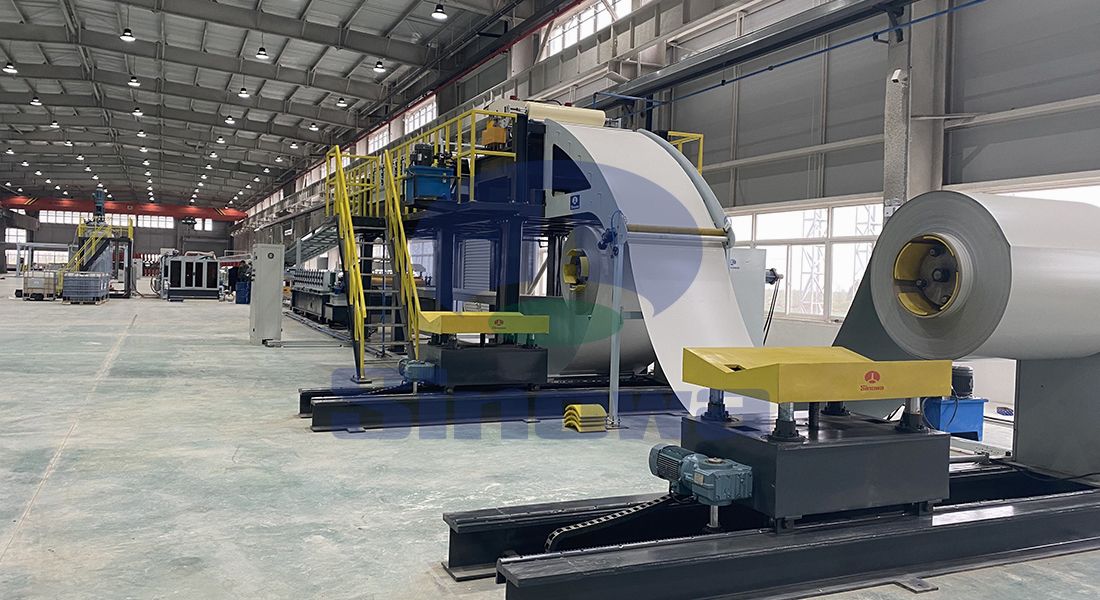
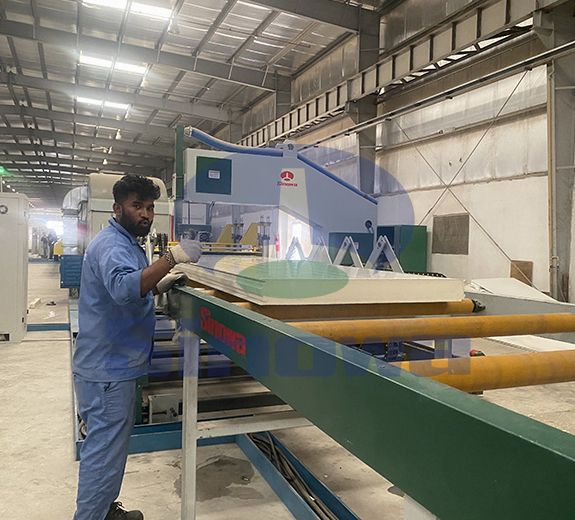
Sinowa is a well-known Hard PU Sandwich Panel Line Supplier From China, Dedicated to the research and development of high-end & high-efficiency pu sandwich panel line, Sinowa is comprehensively taking the leading position in terms of efficiency, automation control level, HMI, environment protection and energy consumption, with subversive designs made in some critical technological fields to procure exceptional cost performance and customer-friendly experience for the entire pu sandwich panel line.
The adoption of system integration technology and bus control technology accomplishes the full automatization of integrated and coordinated control of the entire pu sandwich panel line with accessible remote interactive communication. Ranking the first-class level in the world, it is currently the continuous pu sandwich panel line in the market taking a comprehensive lead in high performance.
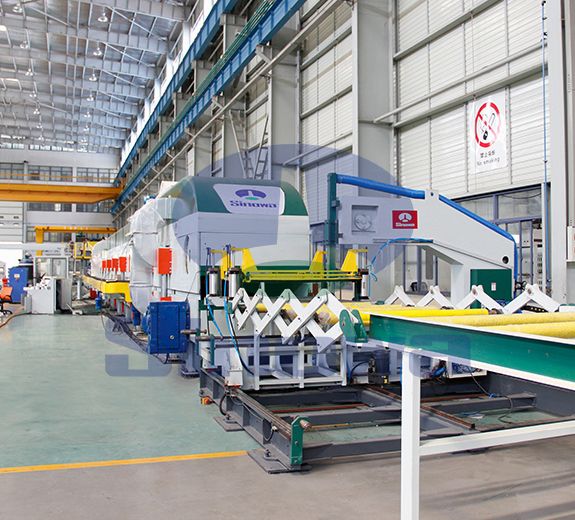
Based on the continuous technological pursuit, the pu sandwich panel line developed by Sinowa provides you with high-efficiency industrial value. Based on China's cost advantage and our hard-working technology concept, our sandwich panel production line has a world-leading price-performance advantage. PU Sandwich Panel Line can meet a variety of production needs of customers.The whole sandwich panel line design concept of modularization enables all our components to be integrated and combined at will.
Our pu sandwich panel line can easily automate the production of roof sandwich panel, wall sandwich panel, cold storage sandwich panel and other products by different combination and configuration selection and siple switching. The inner core layer can be polyrethane or rock wool, glass wool, an so on.
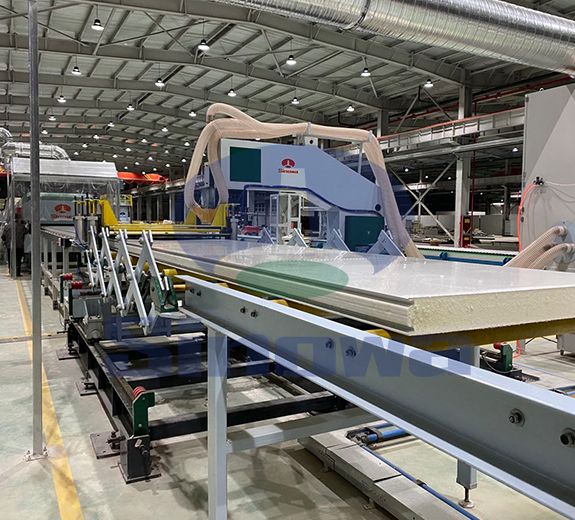
The pu sandwich panel line has high adaptability, which may produce various sandwich panel of the PU, PIR and rock wool systems.
We may design various products according to the customer’s requirements, including various configurations, so as to meet their demands with flexible price system.
Highly integrated and linked control system centralizes all control points at the main central center, achieving parameter linkage, fault self-diagnosis controlled by the whole continuous sandwich panel line and shipping distance control.
High-level automatic control system also saves the manpower and reduces the manpower loss for customers.
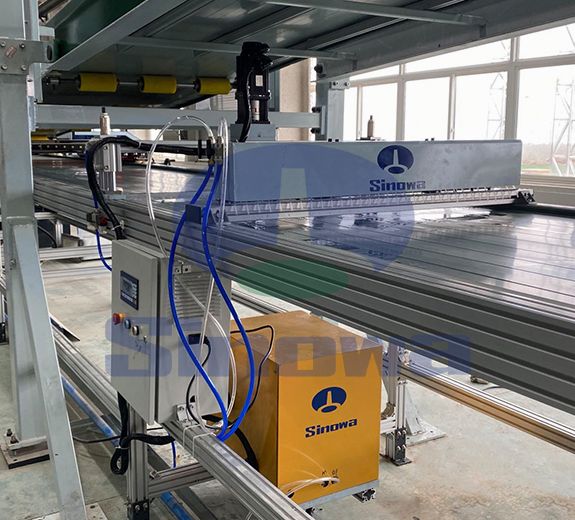
Concentrated system control is fully realized in the practice of concentrated process control so that the control system of all the movements of the parts in the pu sandwich panel line is integrated in one process control console with accessible remote communication to elevate the automation and reduce the allocated number of personnel for the assembly line.
The main engine with modularized design achieves the precision operation of the pu sandwich panel line, stable and reliable quality, less part and maintenance loss.
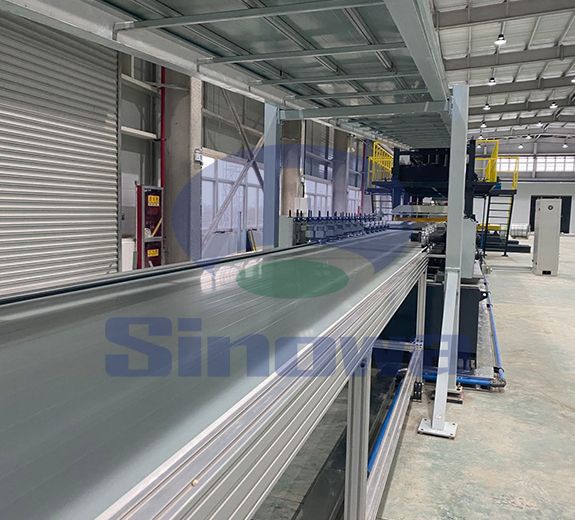
The whole pu sandwich panel line is strictly modularized in design to ensure the greatest probability for the parts to be interchangeable, making it the most cost- and energy-saving. No joining made manually, all the key processes of the parts are completed in the machining center. As soon as the parts are inspected and warehoused, they enter into the assembly process. The modularized assembly can not only greatly increase the production efficiency but, most importantly, realize quick delivery as well. It elevates the reliability of product quality to a totally new level and minimizes the influence from human factors.
The whole pu sandwich panel line has over 40 innovative inventions, making our products have lots of unique features and the comprehensive performance of our production line leading in the industry.
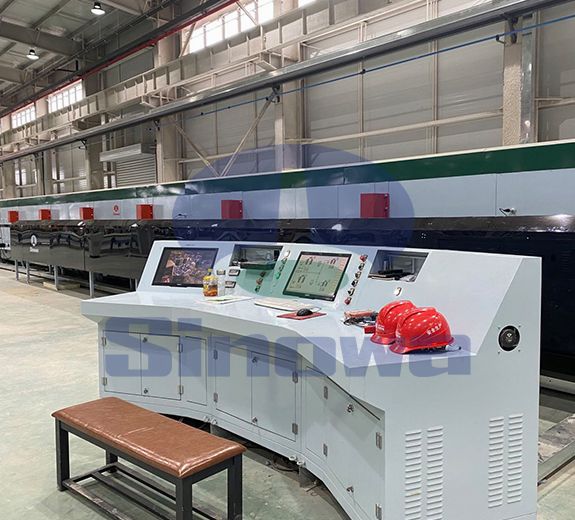
The precision servo hoisting mechanism employed by the main engine without hydraulic system makes the board thickness control flexible and the customer may conveniently change or adjust the board thickness. There will be not such troubles as hydraulic system adjustment, leakage, maintenance, etc.
High-level energy saving and protection design makes the whole pu sandwich panel line possible to produce around the clock throughout the year and the customer will save huge budget. In addition, the isolated heat preservation room is constructed for warming the environment. The energy saving and protection design of our high-tech pu sandwich panel line may guarantee that the customer’s production line may be freely heated and produce in the main time to save more costs for customers.
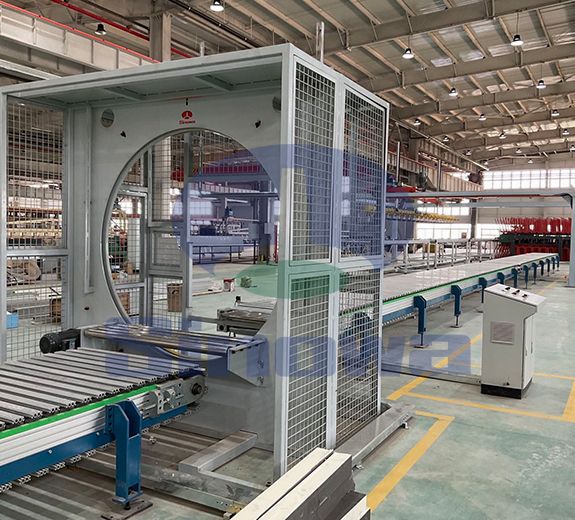
The high-power low-consumption design quickens the reaction of the pu sandwich panel line while energy consumption is kept low.
With the brand-new, fully sealed inner insulation design, the energy consumption is controlled at the minimum level to achieve the design objective of less than an hour for the insulation system to be activated from the room temperature above 5℃ to the production process temperature.
The energy consumption is only 40% that of those similar products.
| PRODUCTION TYPE | PU | PIR | PHENOLIC | |||
|---|---|---|---|---|---|---|
| PRODUCTION USE | INSULATION PANEL | DOCORATIVE PANEL | ||||
| SURFACE OF SHEET | ALUMINUM FOIL | NON-WOVEN FABRIC | PAPER | NAKED | ||
| PRODUCT THICKNESS | 10m--- 200mm | |||||
| PRODUCTION SPEED | 3.0m---25m |
|---|---|
| FOAMING METHOD | TWO OR MULTI COMPONENTS FOAMING |
| FOAMING AGENT | PENTANE OR 141B |
| LENGTH OF LINE | 45m—100m CUSTOMER OPTIONAL |
Sinowa is a well-known manufacturer and technical service provider of high-end polyurethane insulation board production lines and various high-performance cold roll forming machine in China. Our main products include polyurethane double-sided color steel sandwich panel production line, polyurethane and phenolic soft facing insulation panel production line and high-efficiency roll forming machines.
Sinowa has invested outstanding efforts in hard pu sandwich panel line, This is why our products are more efficiency, quality, automatic control technology, environmental protection, energy consumption indicators and the appearance and safety protection are comprehensively leading, Some subversive design changes in many major technical points,these major innovations make our products excellent in price/performance and user experience.
Sinowa is committed to the development and manufacturing of high-end and high-efficiency hard pu sandwich panel line. Our sandwich panel production lines are leading the way in efficiency, automatic control, human-computer interaction, environmental protection and energy consumption. Using system integration and bus control technology, it realizes the automatic integrated linkage control of the entire production line, and can achieve remote interactive communication, which has the world-class level and a comprehensive leading high-performance production line in the market.
The manufacturing sector of composite building materials has undergone remarkable technological evolution over the past decades, and hard PU sandwich panels have gradually become one of the most indispensable materials in modern construction, cold chain logistics and industrial enclosure projects. A complete hard PU sandwich panel line serves as the core equipment for mass production of such high-performance composite panels, integrating raw material processing, continuous molding, thermal curing, precise cutting and post-processing procedures into an interconnected automated production system. This systematic production line is designed to realize continuous and streamlined manufacturing of rigid polyurethane sandwich panels, ensuring consistent structural stability, excellent thermal insulation performance and reliable surface flatness of finished panels. With the growing market demand for energy-saving building materials and durable industrial panels, the optimization and upgrading of hard PU sandwich panel production lines have become a key focus in the composite material manufacturing industry, driving the continuous improvement of production efficiency and product quality standards across the industry.

To understand the operational logic of a hard PU sandwich panel line, it is essential to clarify the basic structural characteristics of hard PU sandwich panels. These panels adopt a typical three-layer composite structure, with dense and rigid polyurethane foam as the core interlayer and smooth metal or non-metal sheets as the upper and lower surface layers. Different from flexible sandwich panels, the rigid polyurethane core features high density, uniform cellular structure and outstanding compressive strength, which endows the finished panels with strong deformation resistance and structural stability. The production line is specially customized to adapt to the physical and chemical properties of hard PU materials, realizing the accurate control of foaming reaction, composite bonding and curing molding throughout the production process. Every functional module in the production line is closely coordinated to avoid common defects such as uneven foam density, weak bonding between surface layer and core layer, and surface warping that frequently occur in traditional intermittent production processes.
The overall workflow of a standard hard PU sandwich panel line follows a continuous linear production logic, which can be divided into several interconnected stages including surface material pretreatment, raw material metering and mixing, continuous foaming and composite molding, thermal curing shaping, cooling setting, fixed-size cutting and finished product sorting. Each production stage is equipped with independent mechanical control units, and the whole line adopts linked transmission to ensure the synchronization of material transportation and processing rhythm. At the initial stage of production, the surface materials for panel fabrication are sequentially released from unwinding devices. These surface materials are usually coiled raw materials with smooth surfaces and uniform thickness, and the unwinding mechanism is equipped with tension adjusting components to maintain stable feeding speed and constant surface material tension. This tension control function effectively prevents surface material deviation, wrinkling and stretching deformation during high-speed transmission, laying a foundation for the flatness of finished composite panels. After unwinding, the surface materials will go through a pretreatment link, where surface dust, oil stains and oxide layers are removed through physical dedusting and surface polishing treatments. Clean and dry surface conditions can significantly enhance the bonding adhesion between the surface layer and polyurethane foam core, avoiding interlayer delamination in long-term use.
The raw material metering and mixing module is recognized as the core functional section that determines the internal quality of hard PU sandwich panels. Polyurethane foaming raw materials consist of multiple chemical components, which need to be proportioned in strict accordance with specific physical property requirements. The production line is fitted with high-precision metering transmission devices to control the flow rate of each raw material component within a stable fluctuation range. All raw materials are transported to a dynamic mixing chamber through sealed pipelines, where high-speed stirring is adopted to realize uniform fusion of different components. The mixing process is completed in a closed space to isolate external temperature interference and avoid impurity contamination. After sufficient mixing, the liquid polyurethane composite material is evenly poured on the horizontally moving lower surface material through a special pouring nozzle. The pouring position and material distribution range are precisely adjusted by an automatic control system to ensure that the liquid raw material covers the surface material evenly without accumulation or blank areas, which is crucial for forming a consistent foam core structure.
Following the material pouring process, the production line enters the continuous foaming and composite molding stage. In this link, the liquid polyurethane material begins to undergo chemical foaming reaction under constant ambient temperature. With the gradual expansion of foam volume, the upper surface material is slowly covered on the top of the foaming raw material through a pressure guiding roller set. The composite structure composed of upper and lower surface materials and intermediate foam is then sent to a closed molding tunnel. Inside the tunnel, multiple groups of pressure rollers are arranged in an orderly manner to apply uniform and stable vertical pressure on the composite blank. This continuous pressure constrains the free expansion of polyurethane foam, forcing the foam to form a compact and regular cellular structure and achieve tight bonding with the inner surface of the surface layers. The gap between the upper and lower roller sets in the molding tunnel can be mechanically adjusted to adapt to the production requirements of panels with different thickness specifications. During the pressure compounding process, the horizontal transmission speed of the base material and the foaming expansion rate of polyurethane materials maintain dynamic balance, effectively preventing internal voids, foam cracking and interlayer separation.
Thermal curing treatment is an indispensable procedure to stabilize the physical properties of hard PU sandwich panels. The molding tunnel is equipped with an integrated constant-temperature heating system, which can keep the internal temperature within the optimal reaction range required for polyurethane curing. The chemical cross-linking reaction of polyurethane materials is accelerated under continuous and stable thermal conditions, promoting the gradual solidification and hardening of the foam core. Reasonable temperature gradient setting in the curing tunnel can avoid excessive local temperature that leads to foam aging and yellowing, while eliminating residual stress generated during foaming and compression molding. The length of the curing tunnel is designed based on the foaming reaction cycle of hard polyurethane materials, ensuring that the composite panels can complete sufficient curing reaction before leaving the heating area. Fully cured panels possess stable internal structure, excellent compressive hardness and reliable interlayer bonding strength, which greatly improves the service durability of the finished products.
After high-temperature curing, the hard PU sandwich panels retain a certain residual temperature, and direct cutting and stacking will cause thermal deformation and surface scratch damage. Therefore, an independent cooling system is installed at the rear section of the production line to complete the low-temperature setting of the panels. Most production lines adopt an air cooling structure with circulating ventilation, where natural cold air is continuously conveyed to the surface and side gaps of the panels through ventilation pipelines to achieve uniform heat dissipation. The cooling process is carried out at a slow and steady speed to prevent excessive temperature difference from causing internal structural cracks of the foam. When the panel temperature drops to the ambient temperature range, the internal molecular structure of polyurethane tends to be completely stable, and the surface hardness and flatness of the panel reach the qualified standard. The cooled panels are transported to the cutting area through a synchronous transmission track to carry out fixed-size processing according to preset production parameters.
The cutting module of the hard PU sandwich panel line focuses on dimensional accuracy and cutting surface smoothness. This module is equipped with automatic positioning sensors and high-speed cutting tools. Before cutting, the system completes real-time measurement of panel length through intelligent sensing components, and sends cutting instructions when the panels reach the designated position. The cutting tool adopts vertical cutting mode, which can simultaneously cut the surface layer and foam core without generating jagged burrs and broken foam residues on the cutting section. The cutting speed is matched with the front-end transmission speed to realize non-stop continuous cutting, effectively improving the overall production continuity. In addition, some optimized production lines are equipped with edge trimming devices to polish the four sides of the cut panels, removing tiny burrs and uneven edges generated during cutting. The panels after trimming have neat edges and regular shapes, which simplifies the subsequent on-site installation and assembly procedures.
The post-processing area of the production line includes finished product sorting, surface inspection and packaging protection links. After cutting and trimming, qualified panels are transported to the inspection platform through a conveyor belt. Professional detection components are used to conduct non-destructive inspection on the surface flatness, interlayer bonding tightness and overall thickness uniformity of the panels. Unqualified products with minor defects are screened out manually or automatically for secondary processing, while high-quality finished products enter the packaging link. In order to avoid surface abrasion and extrusion damage during transportation and storage, the outer surface of the panels will be covered with flexible protective films, and multiple panels are stacked neatly with buffer isolation measures. The whole post-processing process is completed in an automated assembly line mode, reducing manual handling frequency and lowering the risk of panel damage caused by human operation.
Compared with intermittent batch production equipment, hard PU sandwich panel lines have prominent technical and production advantages in industrial manufacturing. First of all, the continuous production mode realizes uninterrupted feeding, molding and processing, greatly improving the unit time output of panels and shortening the production cycle of bulk orders. Secondly, the whole production process adopts centralized automatic control, and parameters such as raw material ratio, heating temperature, transmission speed and molding pressure can be adjusted accurately through the control system. This intelligent control mode eliminates the quality fluctuation caused by manual operation errors and ensures the consistency of physical properties of each batch of panels. In addition, the closed production structure reduces the volatilization of chemical raw materials and the generation of processing waste, which not only optimizes the on-site production environment but also improves the utilization rate of raw materials. The mechanical integration design of the production line also simplifies the daily layout of the production workshop, realizing compact arrangement of functional modules and saving workshop space resources.
Hard PU sandwich panels produced by professional continuous production lines have extensive application coverage in multiple industrial fields. In the construction industry, these panels are widely used for the construction of factory workshops, temporary buildings and purification workshops, providing excellent thermal insulation, sound insulation and weather resistance for building envelopes. The rigid foam core can effectively block heat conduction, reducing the energy consumption of building temperature regulation throughout the year. In the cold chain logistics industry, the panels serve as the main manufacturing materials for refrigerated carriage compartments and constant-temperature storage warehouses. Their low thermal conductivity ensures stable internal low-temperature environment, minimizing cold air loss and improving the energy-saving effect of refrigeration equipment. Besides, the panels are also applied in industrial enclosure engineering such as outdoor partition walls and container houses. Their high compressive strength and corrosion resistance enable them to maintain stable structural performance in complex outdoor environments, resisting the erosion of temperature changes, humid air and wind sand.
Daily maintenance and scientific operation management are essential to extend the service life of hard PU sandwich panel lines and maintain stable production capacity. In terms of daily maintenance, the transmission rollers, sealing pipelines and stirring components in contact with raw materials need regular cleaning to prevent residual polyurethane materials from solidifying and adhering to mechanical surfaces, which may affect equipment operation accuracy. The tension control system and cutting transmission device should be lubricated and debugged periodically to reduce mechanical friction loss and ensure flexible operation of movable parts. The heating and cooling systems need regular circuit and pipeline inspection to eliminate potential risks such as pipeline blockage and circuit aging. In terms of production operation, operators need to adjust production parameters reasonably according to the ambient temperature and raw material characteristics to adapt to the physical state changes of polyurethane materials in different environments. It is also necessary to monitor the operating status of each module in real time during the production process, and shut down the equipment for inspection in case of abnormal vibration, noise and temperature fluctuation to avoid equipment failure expansion.
With the continuous progress of composite material manufacturing technology, the upgrading direction of hard PU sandwich panel line is gradually clear. In the future, such production lines will develop towards higher automation intelligence, more energy-saving environmental protection and stronger production compatibility. The intelligent control system will realize automatic data monitoring and parameter optimization, and independently adjust production parameters according to raw material batches and panel specifications to further improve product qualification rate. In terms of energy conservation, the heating and cooling systems will adopt circulating energy-saving structures to reduce energy consumption in the production process and lower the carbon emission of unit products. In addition, the production line will strengthen the compatibility of diversified raw materials, realizing the mixed production of panels with different surface materials and core densities, so as to meet the personalized customization needs of different industries. While improving production efficiency, the optimized production line will also optimize the production noise and waste discharge indicators to adapt to the increasingly strict industrial environmental protection standards.
In conclusion, the hard PU sandwich panel line is a highly integrated and systematic composite material manufacturing equipment, which combines mechanical transmission, chemical reaction control and intelligent monitoring technology to complete the efficient production of high-performance rigid polyurethane sandwich panels. From raw material pretreatment to finished product packaging, every production link is precisely controlled by professional mechanical structures and control systems, ensuring the excellent performance and stable quality of finished panels. Driven by the booming demand for energy-saving composite materials in the construction, logistics and industrial fields, the hard PU sandwich panel manufacturing industry will usher in a longer development cycle. Continuous technological optimization, standardized operation management and reasonable equipment maintenance will help production lines maintain efficient and stable production capacity, and continuously provide high-quality hard PU sandwich panels for various industrial scenarios, making important contributions to the upgrading of modern composite building material industry.
«Hard PU Sandwich Panel Line» Update Date:2026/5/11
URL: https://www.sinowa.cn/en/blog/hard-pu-sandwich-panel-line.html
Tags: PU Sandwich Panel Lines , Continuous PU Sandwich Panel Line ,
