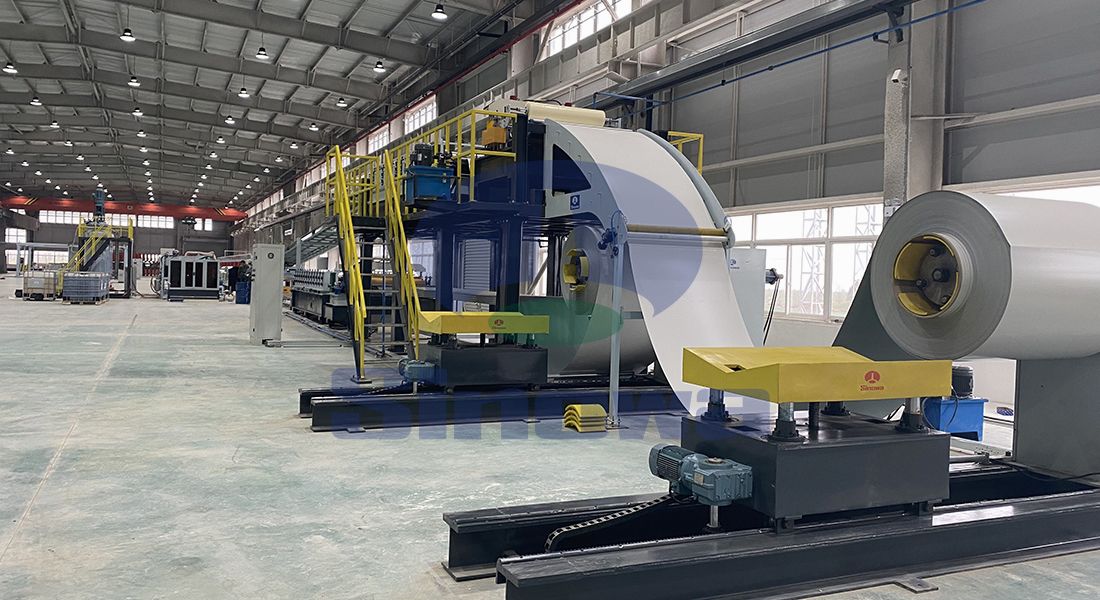
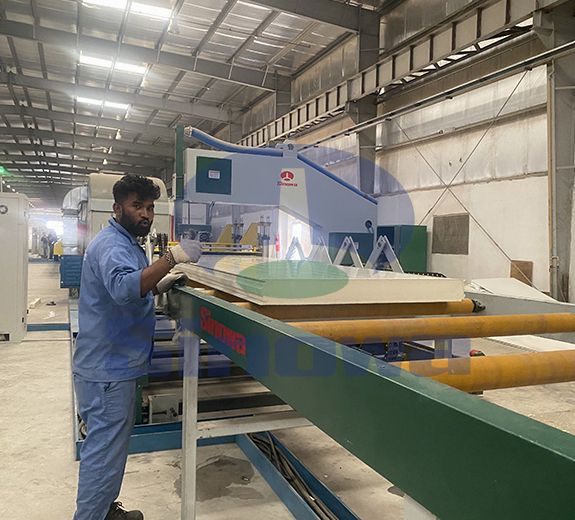
Sinowa is a well-known High Precision Composite PU Sandwich Panel Line Supplier From China, Dedicated to the research and development of high-end & high-efficiency composite pu sandwich panel line, Sinowa is comprehensively taking the leading position in terms of efficiency, automation control level, HMI, environment protection and energy consumption, with subversive designs made in some critical technological fields to procure exceptional cost performance and customer-friendly experience for the entire composite pu sandwich panel line.
The adoption of system integration technology and bus control technology accomplishes the full automatization of integrated and coordinated control of the entire composite pu sandwich panel line with accessible remote interactive communication. Ranking the first-class level in the world, it is currently the continuous pu sandwich panel line in the market taking a comprehensive lead in high performance.
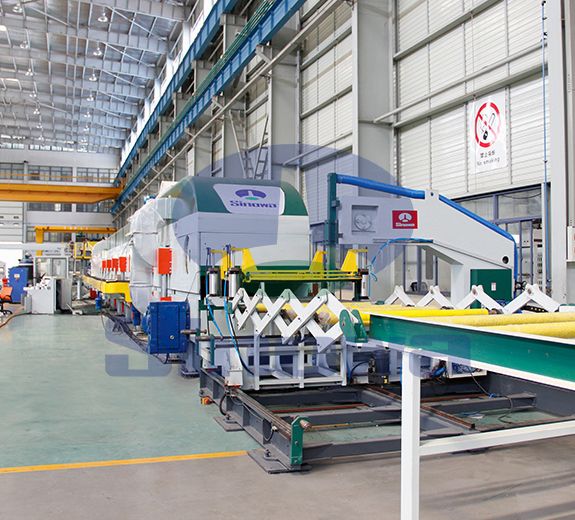
Based on the continuous technological pursuit, the composite pu sandwich panel line developed by Sinowa provides you with high-efficiency industrial value. Based on China's cost advantage and our hard-working technology concept, our sandwich panel production line has a world-leading price-performance advantage. Composite PU Sandwich Panel Line can meet a variety of production needs of customers.The whole sandwich panel line design concept of modularization enables all our components to be integrated and combined at will.
Our composite pu sandwich panel line can easily automate the production of roof sandwich panel, wall sandwich panel, cold storage sandwich panel and other products by different combination and configuration selection and siple switching. The inner core layer can be polyrethane or rock wool, glass wool, an so on.
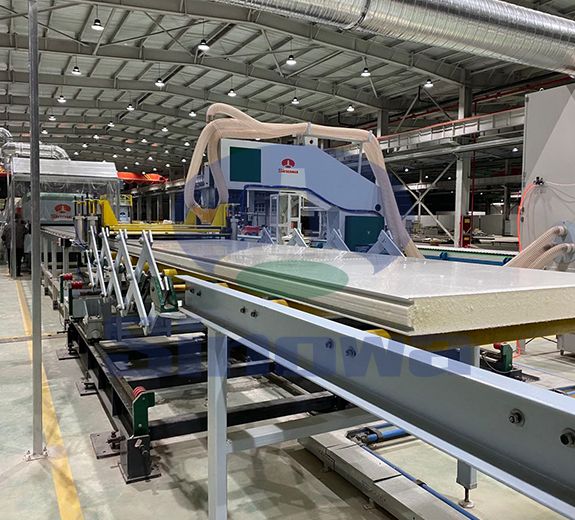
The composite pu sandwich panel line has high adaptability, which may produce various sandwich panel of the PU, PIR and rock wool systems.
We may design various products according to the customer’s requirements, including various configurations, so as to meet their demands with flexible price system.
Highly integrated and linked control system centralizes all control points at the main central center, achieving parameter linkage, fault self-diagnosis controlled by the whole continuous sandwich panel line and shipping distance control.
High-level automatic control system also saves the manpower and reduces the manpower loss for customers.
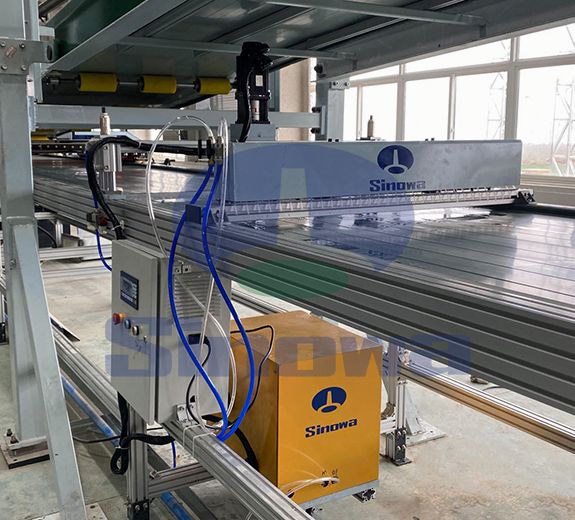
Concentrated system control is fully realized in the practice of concentrated process control so that the control system of all the movements of the parts in the composite pu sandwich panel line is integrated in one process control console with accessible remote communication to elevate the automation and reduce the allocated number of personnel for the assembly line.
The main engine with modularized design achieves the precision operation of the composite pu sandwich panel line, stable and reliable quality, less part and maintenance loss.
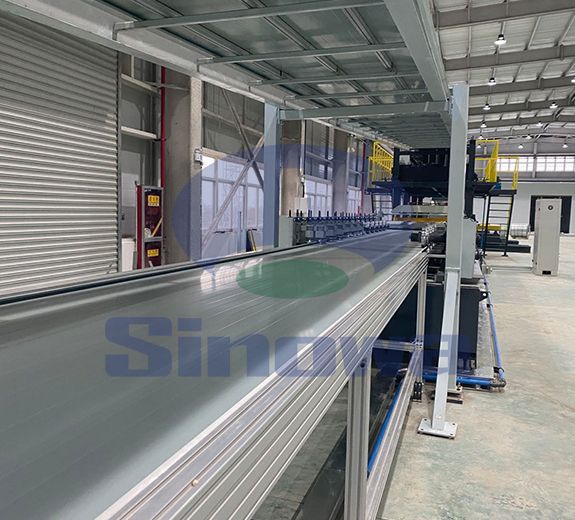
The whole composite pu sandwich panel line is strictly modularized in design to ensure the greatest probability for the parts to be interchangeable, making it the most cost- and energy-saving. No joining made manually, all the key processes of the parts are completed in the machining center. As soon as the parts are inspected and warehoused, they enter into the assembly process. The modularized assembly can not only greatly increase the production efficiency but, most importantly, realize quick delivery as well. It elevates the reliability of product quality to a totally new level and minimizes the influence from human factors.
The whole composite pu sandwich panel line has over 40 innovative inventions, making our products have lots of unique features and the comprehensive performance of our production line leading in the industry.
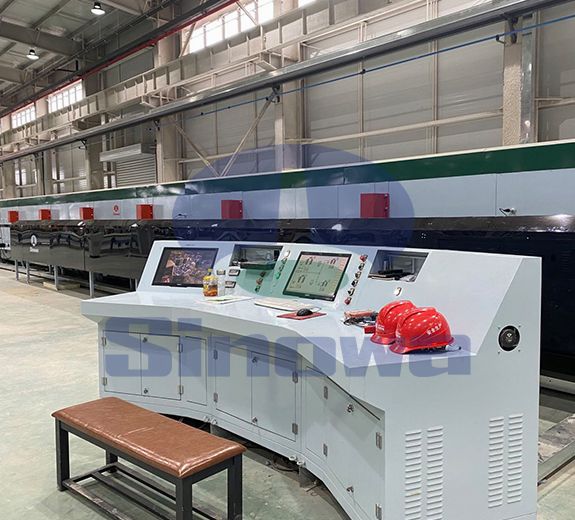
The precision servo hoisting mechanism employed by the main engine without hydraulic system makes the board thickness control flexible and the customer may conveniently change or adjust the board thickness. There will be not such troubles as hydraulic system adjustment, leakage, maintenance, etc.
High-level energy saving and protection design makes the whole composite pu sandwich panel line possible to produce around the clock throughout the year and the customer will save huge budget. In addition, the isolated heat preservation room is constructed for warming the environment. The energy saving and protection design of our high-tech composite pu sandwich panel line may guarantee that the customer’s production line may be freely heated and produce in the main time to save more costs for customers.
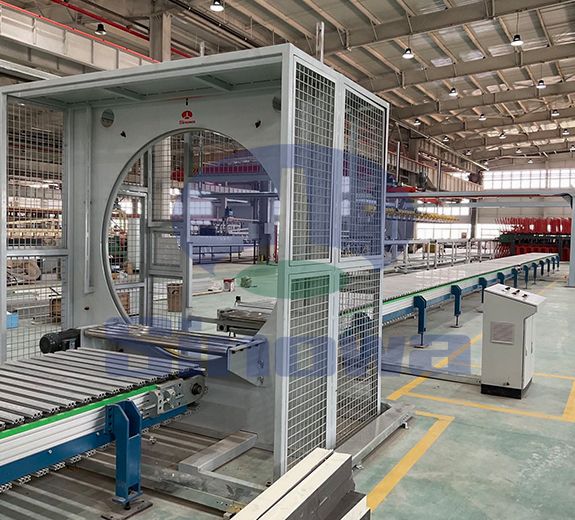
The high-power low-consumption design quickens the reaction of the composite pu sandwich panel line while energy consumption is kept low.
With the brand-new, fully sealed inner insulation design, the energy consumption is controlled at the minimum level to achieve the design objective of less than an hour for the insulation system to be activated from the room temperature above 5℃ to the production process temperature.
The energy consumption is only 40% that of those similar products.
| PRODUCTION TYPE | PU | PIR | PHENOLIC | |||
|---|---|---|---|---|---|---|
| PRODUCTION USE | INSULATION PANEL | DOCORATIVE PANEL | ||||
| SURFACE OF SHEET | ALUMINUM FOIL | NON-WOVEN FABRIC | PAPER | NAKED | ||
| PRODUCT THICKNESS | 10m--- 200mm | |||||
| PRODUCTION SPEED | 3.0m---25m |
|---|---|
| FOAMING METHOD | TWO OR MULTI COMPONENTS FOAMING |
| FOAMING AGENT | PENTANE OR 141B |
| LENGTH OF LINE | 45m—100m CUSTOMER OPTIONAL |
Sinowa is a well-known manufacturer and technical service provider of high-end polyurethane insulation board production lines and various high-performance cold roll forming machine in China. Our main products include polyurethane double-sided color steel sandwich panel production line, polyurethane and phenolic soft facing insulation panel production line and high-efficiency roll forming machines.
Sinowa has invested outstanding efforts in high precision composite pu sandwich panel line, This is why our products are more efficiency, quality, automatic control technology, environmental protection, energy consumption indicators and the appearance and safety protection are comprehensively leading, Some subversive design changes in many major technical points,these major innovations make our products excellent in price/performance and user experience.
Sinowa is committed to the development and manufacturing of high-end and high-efficiency high precision composite pu sandwich panel line. Our sandwich panel production lines are leading the way in efficiency, automatic control, human-computer interaction, environmental protection and energy consumption. Using system integration and bus control technology, it realizes the automatic integrated linkage control of the entire production line, and can achieve remote interactive communication, which has the world-class level and a comprehensive leading high-performance production line in the market.
The high precision composite PU sandwich panel line represents a sophisticated integrated production system built to deliver consistent, reliable panel products with tight dimensional tolerances across every production cycle. At the core of this line lies a coordinated sequence of processing units that work in synchronization, handling surface material feeding, continuous foaming, pressing, curing, trimming and final output without frequent manual intervention. Unlike simpler setups that rely heavily on individual machine adjustments, this system is engineered to maintain stable material distribution as liquid polyurethane components mix and expand between two face layers. Operators can adjust core parameters through a centralized control interface, regulating flow rates, line speed and temperature profiles to match different panel thicknesses and surface material types. Careful attention is paid to the mixing stage, where even minor fluctuations in the ratio of raw materials would create uneven foam density, weak bonding or surface defects on finished panels. The design prioritizes steady pressure during the foaming and curing phase, ensuring the PU core forms a uniform cellular structure that bonds firmly to both facings. This level of control reduces waste from misformed panels and lowers the need for rework after production, supporting long runs of continuous manufacturing with predictable output quality. Every mechanical component that touches raw materials or semi-finished panels is manufactured to precise fitment standards, minimizing vibration and positional drift as the line runs for extended hours.

Material feeding modules form the starting point of the production workflow and are tailored to handle a wide range of flexible and rigid face sheets that form the outer layers of PU sandwich panels. Each feeding station holds large rolls or stacked sheets, guiding materials into the subsequent process with controlled tension to prevent wrinkling, stretching or misalignment before they meet the liquid PU mixture. Tension control mechanisms operate independently for the top and bottom facings, accounting for differences in material stiffness and surface smoothness that could otherwise pull layers out of alignment. Guide rollers and edge positioning sensors continuously track the position of incoming facings, making tiny automatic corrections to keep material edges parallel as they advance along the line. Before foaming begins, surface preparation sections clean away dust and fine contaminants that might interfere with adhesion between the PU foam core and the face materials. Some configurations include optional surface treatment functions to modify surface energy, further improving the bond strength once the polyurethane reacts and solidifies. The feeding system is designed for quick transitions between different facing materials, cutting down changeover time when shifting from one panel specification to another. Smooth material handling also protects decorative or coated surfaces from scratches and marks, preserving the visual quality that customers expect from finished sandwich panels.
The polyurethane metering and mixing unit serves as one of the most critical sections within the high precision composite PU sandwich panel line, governing the chemical reaction that creates the insulating foam core. Two or more liquid raw material streams are pumped separately through precision metering pumps, which deliver each component at an accurately calibrated flow rate to the mixing head. Inside the mixing chamber, high-speed agitation blends the liquid streams thoroughly in a very short window, right before the mixture is deposited evenly onto the lower facing material. Timing is essential here because the mixed PU formulation begins to react and expand immediately after blending, so the system must spread the liquid across the full width of the panel at a consistent thickness before foam rise starts in earnest. The mixing head travels horizontally across the width of the moving substrate, following a carefully programmed path to avoid gaps, streaks or areas with excessive material buildup. Built-in monitoring tracks pressure and flow conditions inside the delivery circuit, detecting blockages or pressure variations that would disrupt uniform foam formation. Operators can fine-tune the mixing recipe to adjust foam hardness, cell structure and thermal performance characteristics of the finished core, adapting output for different functional requirements. All wetted parts of the mixing assembly are engineered for easy flushing and cleaning between batches to prevent residual cured material from compromising future production runs.
Continuous double belt pressing comes directly after foam dispensing, creating the confined space where the PU mixture expands, rises and cures into a solid core bonded securely to both upper and lower face sheets. The two endless steel belts move at the same linear speed as the incoming materials, forming a closed, constant-height cavity that defines the final thickness of the sandwich panel. Adjustable spacing between the belts can be set to accommodate a broad spectrum of panel dimensions, while the heavy frame structure resists deflection under the internal pressure generated by expanding foam. Heating elements integrated into the belt assembly maintain a stable thermal environment inside the press zone, supporting consistent chemical curing without hot spots that could degrade the foam or damage outer facings. Uniform pressure distribution across the entire panel width eliminates hollow areas, compressed core sections and delamination between foam and facings. The belt surface is treated to resist adhesion from uncured PU, allowing the newly formed composite panel to separate cleanly once it exits the pressing zone. This continuous pressing approach delivers far better consistency than discontinuous batch pressing, especially for long-length panels used in modular construction and enclosure systems. Vibration damping features built into the press frame keep the belt path stable, preserving the dimensional accuracy that defines high precision production.
The curing tunnel extends the controlled thermal environment after the panel leaves the double belt press, giving the polyurethane core additional time to complete its cross-linking reaction and stabilize its physical properties. Temperature zones inside the tunnel follow a gradual profile rather than a single fixed setting, matching the natural curing progression of the PU foam as it travels through. Air circulation systems move warm air evenly around the panel without creating harsh airflow that might deform the still-maturing foam structure. Sensors placed at intervals along the tunnel track surface and core temperature, feeding data back to the main control system to adjust heating output automatically. Proper curing reduces the risk of later dimensional shifting, shrinkage or internal stress within the composite panel once it is cut and put into service. The length of the curing tunnel can be matched to the maximum operating speed of the whole line, so production throughput does not outpace the chemical reaction time required for full stabilization. Panels move through the tunnel on low-friction support surfaces that avoid scratching finished faces, maintaining the aesthetic integrity of coated and textured facings. This stage is often underestimated, yet insufficient curing is a common source of long-term performance issues in lower-quality sandwich panel production.
Once panels emerge from the curing section, the line moves into the continuous trimming and edge finishing stage, which shapes the raw continuous composite into clean, uniform widths with straight, square edges. Rotary cutting tools and side trimming units remove excess material from both sides of the panel, correcting minor edge deviations accumulated in earlier stages and creating repeatable panel widths for downstream use. Cutting speeds are synchronized perfectly with the forward speed of the panel, so there is no dragging or tearing of the foam core or face layers during trimming. Dust and fine foam debris generated during cutting are captured by integrated extraction hoods, keeping the work area clean and preventing particles from sticking to panel surfaces. Some edge processing stations also form interlocking profiles along the panel edges, creating tongue-and-groove or joint shapes that simplify assembly when panels are installed on site. Tool positioning can be reconfigured digitally to switch between different edge profiles without manual repositioning of heavy cutting equipment. Edge quality directly impacts how tightly panels fit together during installation, so precise trimming reduces gaps and improves the sealing performance of assembled wall and roof systems. After side trimming, cross-cut saws separate the endless continuous panel into individual finished lengths according to preset size requirements.
The cross-cutting station is designed to sever the moving continuous panel into discrete finished pieces while maintaining perpendicular cut ends and accurate length measurement. A flying saw mechanism travels in tandem with the moving panel during the cut cycle, matching line speed so there is no relative movement that would produce jagged or angled cuts. Length measurement is handled by high-resolution encoders paired with position sensors, which register travel distance and trigger the cutting sequence at the exact target dimension. The cutting blade is selected to slice cleanly through both the outer facings and the compressible PU foam core without crushing the cellular structure near the cut edge. Clamping fixtures hold the panel securely only during the brief cutting operation, releasing immediately afterward so the piece can continue forward on the conveyor. Operators can store multiple length recipes within the control system, allowing the line to alternate between different finished panel lengths within a single production run. Cut tolerances are kept very tight to ensure panels fit as intended in pre-designed layouts for building envelopes and insulated enclosures. After cutting, small burrs and loose foam fragments at the cut ends are brushed away automatically before panels proceed to inspection.
Automated inspection and quality monitoring run alongside the physical production flow, capturing real-time data to verify that each panel meets the target specifications set for the current batch. Non-contact sensors scan panel width, thickness, surface flatness and surface defects as panels pass through the inspection zone, flagging any unit that falls outside predefined acceptable ranges. The system records each measured parameter alongside production timestamp information, creating a traceable record of manufacturing conditions for every panel produced. Visual inspection modules detect surface marks, discoloration, bubbles, wrinkles and areas of poor bonding that may not be visible to the human eye at normal production speeds. When a non-conforming panel segment is identified, the system can mark it for separation at the sorting station without halting the rest of the continuous line. This approach avoids the slowdowns that come with full-line stoppages for occasional defects. Inspection data is displayed on the main operator screen, revealing trends such as gradual drift in thickness or mixing ratio that can be corrected before large volumes of out-of-spec product accumulate. Human inspectors still perform periodic spot checks to validate automated readings, combining machine consistency with human judgment for subtle quality attributes.
Sorting, stacking and protective packaging functions form the final operational segment of the high precision composite PU sandwich panel line, preparing finished panels for safe transport and storage. After inspection, panels are diverted automatically to separate stacking lanes according to their specification, length or quality status. Stacking manipulators lift and place panels gently onto stable stacks, using soft contact surfaces to avoid denting, scratching or compressing the foam core. Stack height is controlled to prevent excessive weight from damaging panels at the bottom of each pile. Once a stack reaches the target size, wrapping systems apply protective film or separating layers over the surface to shield facings from dirt, moisture and abrasion during handling and shipping. Edge protection elements can be fitted automatically to vulnerable corners and cut ends, which are prone to chipping and damage in transit. The stacking sequence can be adjusted to alternate panel orientation as needed, reducing the risk of warping while stacked. This end-of-line automation reduces heavy manual lifting for workers and speeds up the flow from finished production to warehouse staging. Consistent stacking also makes loading onto transport vehicles more efficient and reduces product losses caused by careless handling after manufacturing.
The overall control architecture that ties every section of the high precision composite PU sandwich panel line together is built around a unified programmable platform that coordinates speed, timing, temperature and actuation across dozens of individual machine axes. All process parameters are centralized on an intuitive graphical interface, where authorized operators can call up saved production recipes and observe live readings from sensors distributed across the line. Interlocks are programmed to pause specific upstream functions if a downstream station becomes congested, preventing jams and material buildup that could damage machinery or ruin unfinished panels. Diagnostic functions track the operating state of pumps, motors, heaters and sensors, alerting maintenance teams to abnormal performance before a component failure stops production entirely. Data logging stores historical process information for review, helping engineering teams refine recipes and identify opportunities to boost stability and reduce material consumption. The control framework supports incremental upgrades, so additional inspection modules or modified forming tools can be integrated later without replacing the whole production system. Training for operators focuses on understanding cause-and-effect relationships between adjustments and panel quality, rather than only memorizing button sequences. As demand grows for composite panels with stable insulation performance and accurate dimensions, this type of well-integrated, high-precision production line provides the reliable manufacturing foundation needed to meet evolving market expectations for composite insulated building components.
composite pu sandwich panel line, composite pu sandwich panel line manufacturer, composite pu sandwich panel line for sale, composite pu sandwich panel line supplier, China composite pu sandwich panel line, Custom composite pu sandwich panel line
«High Precision Composite PU Sandwich Panel Line» Update Date:2026/10/26
URL: https://www.sinowa.cn/en/blog/high-precision-composite-pu-sandwich-panel-line.html
Tags: PU sandwich panel line , PU sandwich panel machine , PU sandwich panel production line , sandwich panel line , sandwich panel machine , sandwich panel production line
