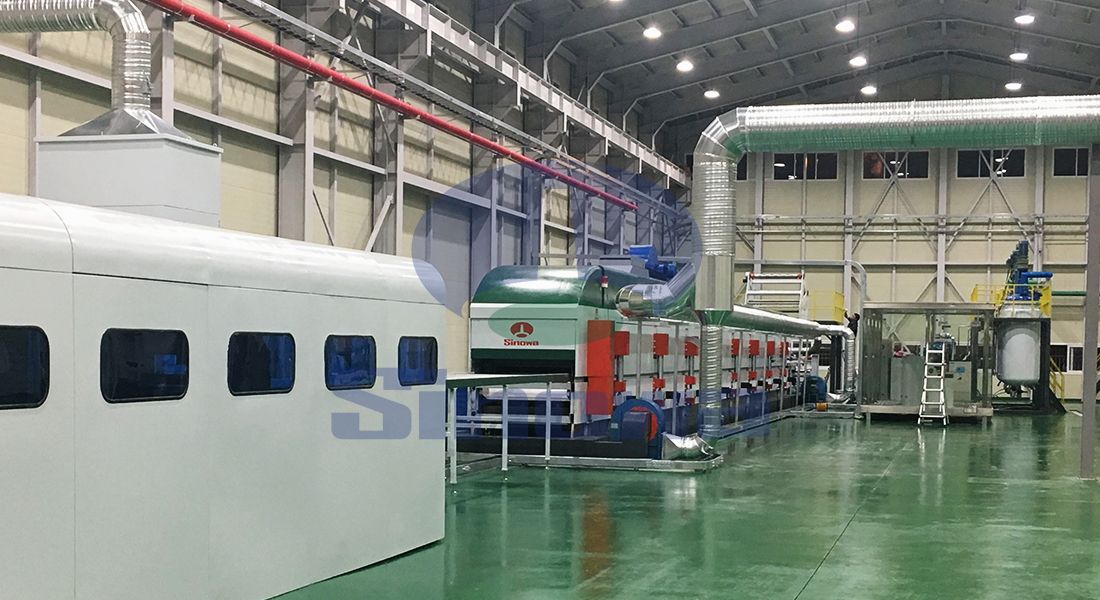
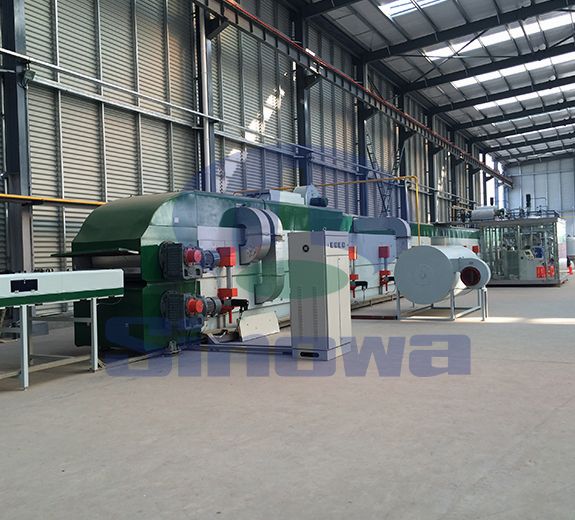
Sinowa is a well-known Insulation Board Production Line Supplier From China, Continuous Insulation Panel Production Line of the PU and phenolic aldehyde surface has diversified and multifunctional production characteristics, which may produce products with different specifications such as PU, PF, PIR, etc.
The surface material may be aluminum foil, colored steel, cement base cloth, kraft paper, non-woven fabrics, etc.
The products are widely applied to such occasions as construction, decoration, pipeline ventilation, subway construction, etc.
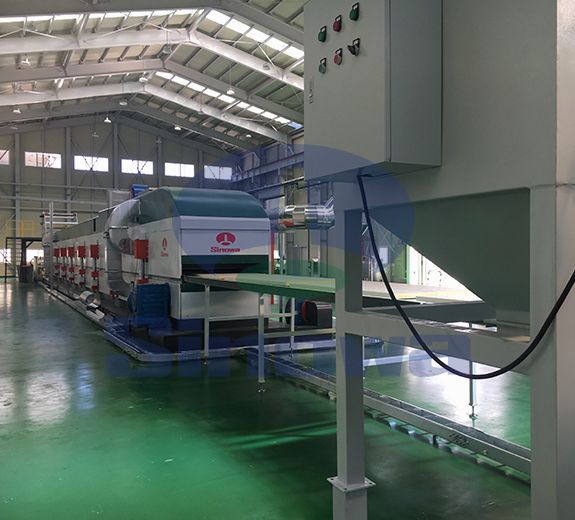
The insulation board production line of soft layer insulation board is able to continuously and efficiently produce high-quality PU and Phenolic insulation boards.
We spare no efforts to improve our product quality and technological reliability by employing the most cutting-edge and the most reliable support and processes to make our products highly reliable and endurable. As a result, the insulation board production line of our soft layer insulation panels is highlighted by many perfect qualities. It is the core idea in Sinowa's product roadmap to surpass our competitors in terms of design philosophy, manufacture methods and service level, going for excellence and leading position and making constant improvement on our products and services, which is also our core value system to create efficiency and convenience for our customers.
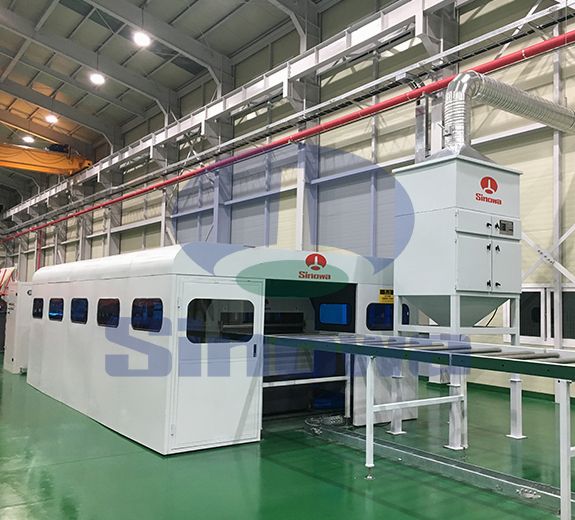
Well-grounded on our solid strength as a renowned large-scale enterprise, Sinowa has a high starting point in developing industrial assembly lines.
Based on the advanced science and technology introduced from within and without the country and supported by a great number of first-grade parts and components from the home and aboard, these assembly lines have a high-level configuration of supporting products in terms of machinery, electrical control, hydraulic pressure, automatic measurement and tracking, and so on.
This is a strong proof of our product’s reliable quality and high efficiency.
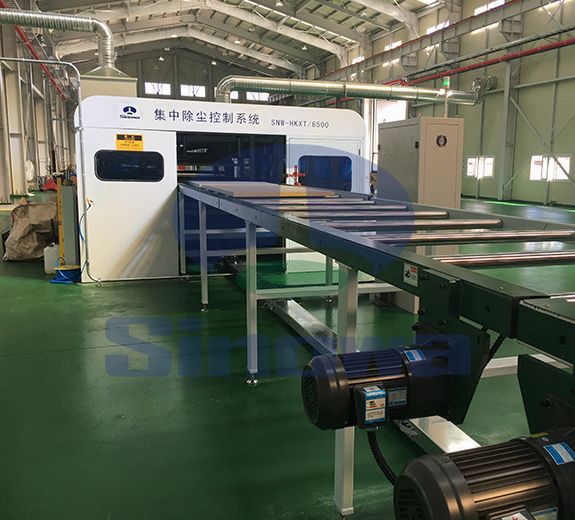
The first-class appearance design and excellent energy saving measures make it unnecessary for customers to additionally construct the heat preservation and isolation room for production around the clock throughout the year, so that the customers may save lots of resources and costs.
Modularized standard design and important parts machined with CNC machine tool make the production line have excellent quality assurance. Dependence on the man-made factors is eliminated. The operation is precision, with the highest operation speed of 30m/min. The insulation board production line has the world-class production efficiency.
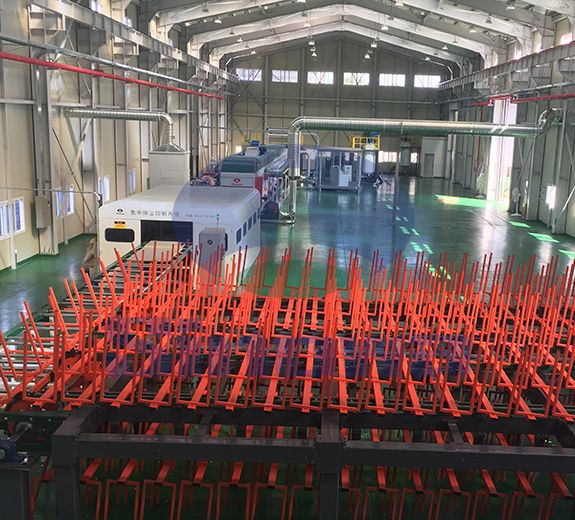
The high performance and reliable multicomponent cyclopentane foaming technology and equipment of Sinowa may be also applied to the foaming process of the phenolic aldehyde board. Therefore, our customers may not only freely adjust the foaming matching according to the raw material, but also save lots of costs. Moreover, they are of significance for environmental protection.
Sinowa's industrial insulation board production line of insulation panels is distinguished by its impressive performance of energy conservation. In each high point of energy consumption throughout the entire pu sandwich panel line are implemented corresponding measures to considerably lower the consumption level.
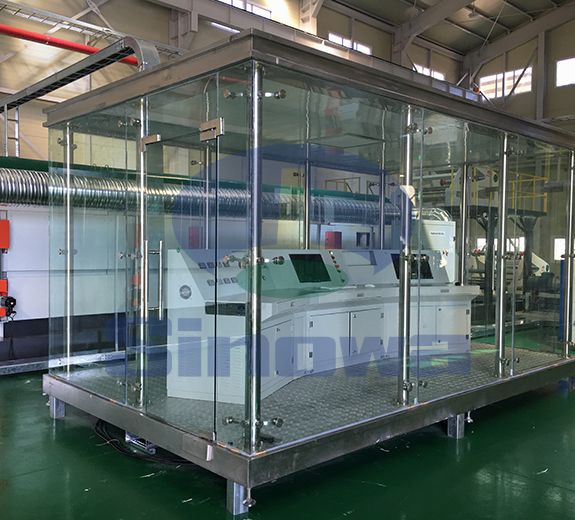
For example, the body of the lamination belt conveyer is covered with insulation panels in very reasonable structures, which doesn’t blemish the overall outlook but greatly increases the insulation performance.
The entire insulation board production line is constantly optimized and improved so that the consumption of each power source is significantly reduced. The motor power of our lamination conveying system is only 3.0 kw, about 50% less than those of the same kind.
All in all, the energy consumption of the whole sandwich panel line equals 40% or even less of the equivalent lines in the market.
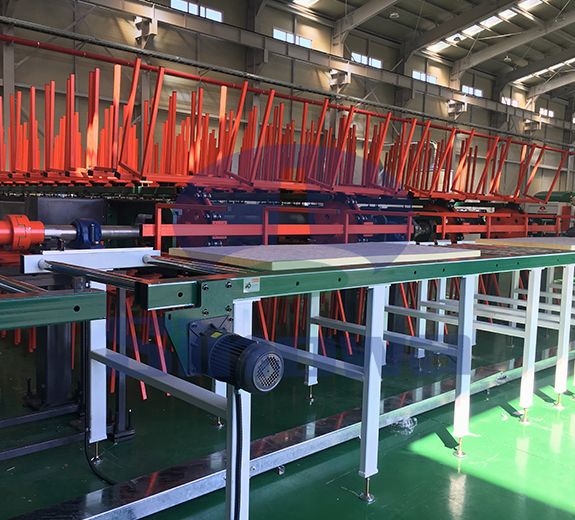
The insulation board production line of Sinowa adopts the most advanced concepts in the world to realize the modularized design with all the parts bolted together rather than welded.
In standardized production, the parts can be dismantled and exchanged, so the production cycle is drastically shortened and the maintenance becomes by far easier.
Through finite element analysis, the equipment design is greatly optimized to realize modularization, digitization, and weight-minimalization.
| PRODUCTION TYPE | PU | PIR | PHENOLIC | |||
|---|---|---|---|---|---|---|
| PRODUCTION USE | INSULATION PANEL | DOCORATIVE PANEL | ||||
| SURFACE OF SHEET | ALUMINUM FOIL | NON-WOVEN FABRIC | PAPER | NAKED | ||
| PRODUCT THICKNESS | 10m--- 200mm | |||||
| PRODUCTION SPEED | 3.0m---25m |
|---|---|
| FOAMING METHOD | TWO OR MULTI COMPONENTS FOAMING |
| FOAMING AGENT | PENTANE OR 141B |
| LENGTH OF LINE | 45m—100m CUSTOMER OPTIONAL |
Sinowa is a well-known manufacturer and technical service provider of high-end polyurethane insulation board production lines and various high-performance cold roll forming machine in China. Our main products include polyurethane double-sided color steel sandwich panel production line, polyurethane and phenolic soft facing insulation panel production line and high-efficiency roll forming machines.
Sinowa has invested outstanding efforts in insulation board production line, This is why our products are more efficiency, quality, automatic control technology, environmental protection, energy consumption indicators and the appearance and safety protection are comprehensively leading, Some subversive design changes in many major technical points,these major innovations make our products excellent in price/performance and user experience.
Sinowa is committed to the development and manufacturing of high-end and high-efficiency insulation board production line. Our sandwich panel production lines are leading the way in efficiency, automatic control, human-computer interaction, environmental protection and energy consumption. Using system integration and bus control technology, it realizes the automatic integrated linkage control of the entire production line, and can achieve remote interactive communication, which has the world-class level and a comprehensive leading high-performance production line in the market.
Insulation board production lines stand as the core industrial manufacturing systems dedicated to the continuous and standardized fabrication of various thermal insulation panels that serve as fundamental functional materials across modern construction, industrial manufacturing, cold chain logistics, and energy conservation engineering fields. These integrated production systems are scientifically designed to combine raw material pretreatment, precise proportioning, forming processing, curing shaping, surface finishing, and fixed-size cutting into a seamless continuous production process, realizing the mass production of insulation boards with stable structural stability, reliable thermal insulation effects, and adaptable mechanical properties. The overall structural design of a complete insulation board production line follows the basic principles of mechanical rationalization, production continuity, and product customization compatibility, with every functional module closely interconnected and coordinated to ensure that each batch of finished insulation boards maintains consistent internal structure uniformity and external dimensional accuracy, laying a solid equipment foundation for the widespread application of insulation materials in various energy-saving and thermal isolation scenarios. With the global emphasis on energy conservation, emission reduction, and green building development, the upgrading and optimization of insulation board production line structures and production technologies have become increasingly prominent, and different structural configurations and production process designs directly determine the core performance indicators, product classification attributes, and applicable application ranges of the final insulation board products, forming a complete industrial production and application system integrating equipment manufacturing, material processing, and terminal scenario matching.

The basic structure of a conventional insulation board production line consists of multiple core functional modules arranged in a sequential production layout, each undertaking exclusive production tasks and cooperating with each other to complete the whole process from raw material input to finished product output. The front-end raw material pretreatment and feeding module is the primary structural part of the entire production line, mainly responsible for the screening, crushing, drying, and automatic quantitative conveying of various base raw materials and auxiliary additives. This structural part is equipped with precision feeding and metering devices to ensure that the proportion of different raw materials in each production cycle remains balanced and stable, avoiding fluctuations in the internal density and structural uniformity of insulation boards caused by uneven raw material proportioning. For different types of insulation board raw materials, this pretreatment module has adjustable structural adaptability, capable of processing inorganic raw materials such as natural rock and mineral slag, organic polymer raw materials including polystyrene and polyisocyanurate, as well as various fiber-based composite raw materials, and completing the fine processing of raw material particle size and moisture content to meet the subsequent forming and processing requirements. The middle core forming and composite pressing module is the most critical structural component of the insulation board production line, which directly determines the internal cellular structure, overall compactness, and basic mechanical strength of the insulation board. This part adopts either continuous lamination forming or intermittent mold pressing structural design according to different production process requirements; the continuous lamination structure is suitable for large-scale batch production of standardized insulation boards, with stable and continuous material pressing and forming speed, small internal thermal bridge effect of products, and excellent overall structural consistency, while the intermittent mold pressing structure has stronger production flexibility, adaptable to the production of special-shaped and multi-specification insulation boards with customized sizes, and can adjust pressing pressure and forming time according to product performance requirements to meet the personalized structural design needs of different insulation boards.
Subsequent to the forming process, the curing and shaping structural module undertakes the key task of stabilizing the internal physical structure and chemical properties of initially formed insulation boards. This structural area is equipped with constant temperature and humidity adjustment equipment and natural or accelerated curing channels, allowing the internal molecular structure and cellular structure of the insulation board to fully stabilize after a certain period of standing and treatment, effectively preventing product deformation, shrinkage, and performance attenuation in the later use process. The curing structure is designed with multi-stage temperature and humidity gradient adjustment functions, which can be adaptively adjusted according to the material characteristics of different insulation boards; organic foam insulation boards need low-temperature slow curing to avoid cellular structure damage, while inorganic fiber insulation boards require moderate temperature strengthening curing to enhance internal fiber bonding strength and overall structural compactness. The rear-end finishing and cutting module is responsible for the final dimensional shaping and surface treatment of cured insulation boards, including fixed-size cutting, edge trimming, surface smoothing, and simple composite laminating treatment. The cutting and trimming structure adopts precise mechanical transmission and positioning design to ensure that the dimensional error of each finished insulation board is controlled within a tiny range, and the surface treatment structure can polish and flatten the board surface according to subsequent application needs, removing burrs and uneven parts generated in the production process, making the insulation board have flat surface and neat edges, convenient for subsequent transportation, stacking, and on-site construction and installation. The entire insulation board production line is also equipped with an integrated transmission and power control structure, connecting all functional modules in series to realize automatic continuous operation of the whole production process, reducing manual intervention links, improving overall production efficiency, and ensuring the stability and safety of long-term production operation.
The structural performance of insulation board production lines is directly reflected in production operation stability, product forming accuracy, process adjustment flexibility, and long-term continuous production adaptability, and these performance indicators fundamentally determine the quality level and service life of finished insulation board products. In terms of mechanical operation performance, high-quality insulation board production lines adopt reinforced frame structures and wear-resistant transmission parts, which can maintain stable operating conditions under long-term high-load continuous production, without mechanical vibration, part wear, or transmission deviation that affect product processing accuracy. The structural anti-fatigue design enables the production line to adapt to uninterrupted production work rhythms in industrial production environments, reducing equipment failure rates and maintenance costs, and ensuring the continuity and efficiency of enterprise production and processing. In terms of process adjustment performance, modern insulation board production lines have flexible structural adjustment functions, which can freely switch production parameters such as raw material proportioning, forming pressure, curing time, and board thickness according to different production needs, realizing the flexible conversion between different types and specifications of insulation board production on the same production line. This flexible adjustment performance greatly improves the utilization rate of production equipment, enables production enterprises to quickly respond to market demand changes, and meets the diversified procurement needs of different terminal customers for insulation board size, thickness, and performance parameters.
In terms of product forming structural performance, the core pressing and forming structure of the production line can achieve uniform pressure distribution and stable temperature control in the forming process, ensuring that the internal cellular structure or fiber distribution of each insulation board is uniform and consistent, without local hollowing, uneven density, or structural defects such as internal cracks. Excellent forming structural performance makes the finished insulation board have balanced thermal insulation performance and mechanical strength in all parts, avoiding the problem of reduced overall thermal insulation effect and local stress damage caused by inconsistent internal structure. In terms of environmental adaptability performance, the overall closed structural design of the insulation board production line can effectively control dust and waste generated in the production process, reduce material waste and environmental pollution in the production process, and meet the requirements of clean and green industrial production. At the same time, the production line structure is adapted to different ambient temperature and humidity production environments, can maintain stable production processing effects in different regional climatic conditions, and will not have production parameter fluctuations and product quality problems due to changes in external environmental factors. The comprehensive structural performance advantages of the production line lay a reliable equipment foundation for the production of high-quality insulation boards, enabling finished products to have excellent thermal insulation, compression resistance, moisture resistance, and weather resistance in subsequent use, and adapt to various complex application scenarios and long-term service working conditions.
According to different raw material formulas, forming processes, and structural design characteristics of production lines, insulation board production lines can be divided into several mainstream types, and each type of production line corresponds to insulation board products with different structural characteristics and performance advantages, targeting different market application fields and usage environments. Extruded polystyrene insulation board production lines are typical organic closed-cell insulation board production equipment, adopting continuous extrusion foaming forming structural design, through high-temperature melting, high-pressure extrusion, and closed-cell foaming processes to produce insulation boards with dense seamless closed-cell internal structure. The production line structure of this type focuses on high-pressure extrusion and precise foaming control modules, with strict control over temperature and pressure parameters in the production process, making the produced extruded insulation boards have ultra-high compressive strength, extremely low water absorption, and excellent structural durability. The internal closed-cell compact structure makes the board not easy to deform under long-term load bearing, and has strong moisture and corrosion resistance, suitable for humid and high-load bearing application environments. Expanded polystyrene insulation board production lines adopt pre-foaming and mold pressing fusion forming structural design, with a relatively simple overall production line structure and strong production cost control advantages; the production process completes board forming through pre-expansion of polystyrene beads and steam heating fusion bonding, and the produced insulation boards have light overall weight, good thermal insulation performance, and low density characteristics. The structural design of this production line focuses on raw material pre-foaming uniformity and mold forming stability, suitable for large-scale production of light thermal insulation insulation boards, and the product cost performance is prominent, favored in general building thermal insulation projects.
Rock wool and inorganic fiber insulation board production lines belong to inorganic high-temperature resistant insulation board production equipment, adopting raw material melting, fiberization, and wet forming pressing structural design. The front-end of the production line is equipped with high-temperature melting and fiber spinning structural modules, which melt natural rock and mineral slag raw materials into fiber filaments, then carry out fiber uniform distribution and composite pressing forming processes. The produced rock wool insulation boards have excellent fire resistance and high-temperature resistance, belonging to non-combustible thermal insulation materials, with good sound absorption and noise reduction performance while maintaining stable thermal insulation effect. The structural design of this production line focuses on high-temperature melting safety and uniform fiber distribution, ensuring that the internal fiber structure of rock wool boards is closely arranged and bonded firmly, avoiding fiber falling off and structural looseness in use. Polyisocyanurate high-performance insulation board production lines are high-end organic thermal insulation board production equipment, adopting continuous composite laminating and rapid curing structural design, with precise control of chemical reaction and foaming forming process in the production process. The produced polyisocyanurate insulation boards have ultra-low thermal conductivity, excellent thermal insulation efficiency, and good fire retardant and weather resistance performance, and the production line structure is optimized for chemical reaction stability and composite forming efficiency, suitable for producing high-performance insulation materials required for high-standard energy-saving buildings and special industrial thermal insulation projects. In addition, integrated insulation and decoration composite board production lines adopt composite laminating structural design, which can complete the composite processing of insulation base board and surface decoration materials in one production process, realizing the integration of thermal insulation and decoration functions of products, and the production line structure is equipped with precise composite bonding and pressing modules to ensure firm bonding between the base board and surface layer, no delamination and peeling in long-term use.
Various insulation boards produced by different types of production lines have diverse and extensive practical uses, covering civil construction, industrial engineering, cold chain logistics, municipal engineering, and special industrial thermal insulation fields, providing reliable thermal insulation, energy saving, fire prevention, and sound insulation support for various projects. In civil building engineering, insulation boards are widely used in exterior wall thermal insulation, roof thermal insulation, floor heating insulation, and basement wall moisture-proof thermal insulation links. Extruded insulation boards with high compression resistance and moisture resistance are mostly used for floor heating insulation and basement thermal insulation parts, effectively reducing heat transfer between building floors and preventing underground moisture from penetrating into the building interior, improving indoor living comfort and building energy-saving effect. Expanded polystyrene insulation boards with cost-effective advantages are mainly used for exterior wall and roof basic thermal insulation of residential buildings and ordinary commercial buildings, reducing indoor and outdoor heat exchange, keeping indoor temperature stable in hot summer and cold winter, and reducing building heating and cooling energy consumption. Rock wool inorganic insulation boards with excellent fire resistance are applied to high-rise buildings, large public buildings, and crowded commercial places, meeting high fire safety design requirements while realizing building thermal insulation, effectively preventing the spread of fire and improving the overall safety performance of buildings.
In industrial engineering production and operation, insulation boards are used for thermal insulation and heat preservation of industrial plant walls, roofs, production equipment, and material storage warehouses. High-performance polyisocyanurate insulation boards are used for thermal insulation of industrial production workshops with strict temperature control requirements, ensuring stable internal production environment temperature, avoiding product quality problems caused by temperature fluctuations in the production process, and reducing industrial production energy consumption. In cold chain logistics and cold storage construction projects, extruded insulation boards with low water absorption and high structural stability are the core thermal insulation materials, used for wall, floor, and top thermal insulation of cold storage and refrigerated logistics warehouses, effectively reducing cold air loss inside cold storage, maintaining long-term stable low-temperature operating environment, reducing refrigeration equipment operating load, and realizing energy-saving and efficient operation of cold chain logistics system. In municipal engineering and infrastructure construction, insulation boards are applied to thermal insulation and frost prevention of municipal pipelines, road foundation frost resistance, and bridge deck thermal insulation protection, avoiding pipeline freezing and cracking in low-temperature environments and road foundation deformation and damage caused by temperature changes, improving the service life and operation stability of municipal infrastructure.
In special industrial fields such as high-temperature industrial kilns, power equipment thermal insulation, and chemical pipeline anti-corrosion and thermal insulation, inorganic fiber rock wool insulation boards produced by professional production lines are widely used, relying on their high-temperature resistance, fire resistance, and chemical corrosion resistance to provide stable thermal insulation and safety protection for high-temperature and corrosive industrial working environments. With the continuous advancement of green building and energy-saving industrial development concepts, the application scope of insulation boards produced by various professional production lines is constantly expanding, and the structural optimization and performance upgrading of insulation board production lines will further promote the improvement of insulation board product quality and the expansion of application scenarios. Continuously optimized production line structures and mature production processes ensure that insulation boards can adapt to more complex and diverse use environments, provide solid material guarantee for global energy conservation and emission reduction and sustainable development of various industries, and realize the dual value of economic energy saving and social green environmental protection in different application fields.
«Insulation Board Production Line» Update Date:2026/4/29
URL: https://www.sinowa.cn/en/blog/insulation-board-production-line.html


