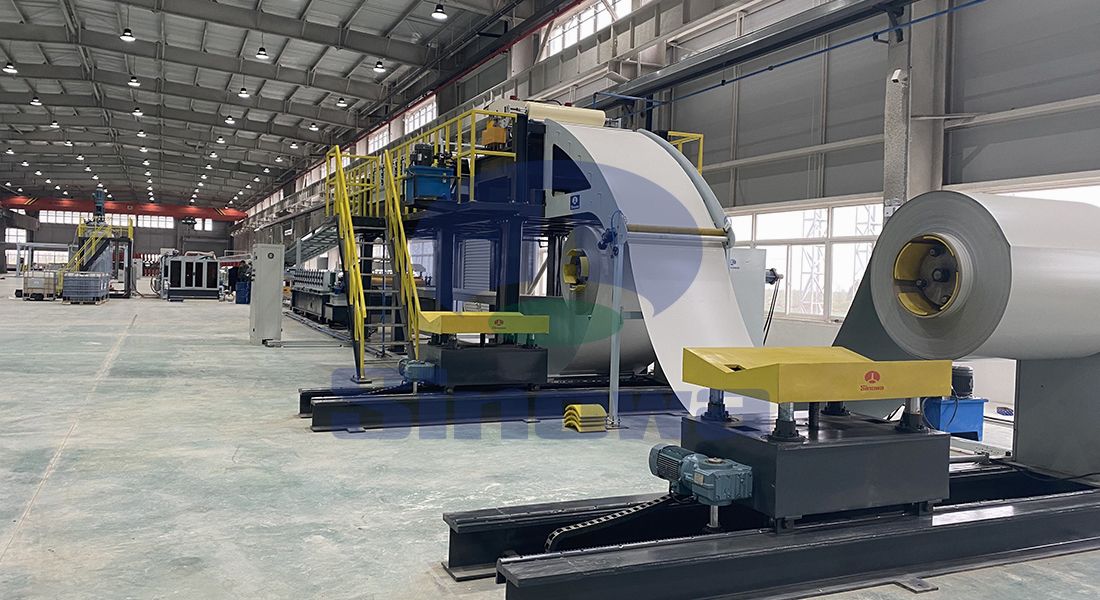
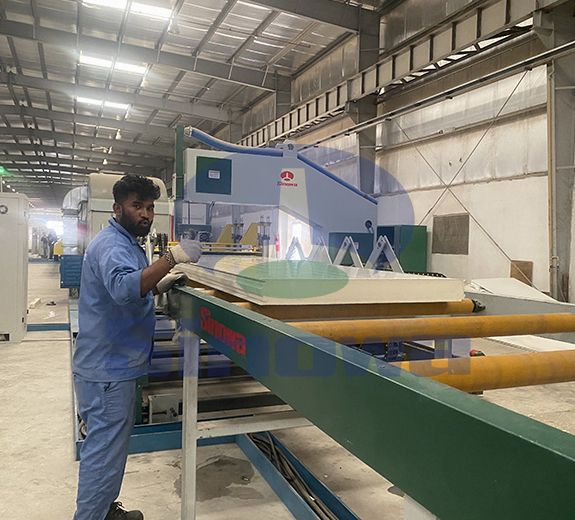
Sinowa is a well-known PU Sandwich Panel Machine Supplier From China, Dedicated to the research and development of high-end & high-efficiency pu sandwich panel machine, Sinowa is comprehensively taking the leading position in terms of efficiency, automation control level, HMI, environment protection and energy consumption, with subversive designs made in some critical technological fields to procure exceptional cost performance and customer-friendly experience for the entire pu sandwich panel machine.
The adoption of system integration technology and bus control technology accomplishes the full automatization of integrated and coordinated control of the entire pu sandwich panel machine with accessible remote interactive communication. Ranking the first-class level in the world, it is currently the continuous pu sandwich panel line in the market taking a comprehensive lead in high performance.
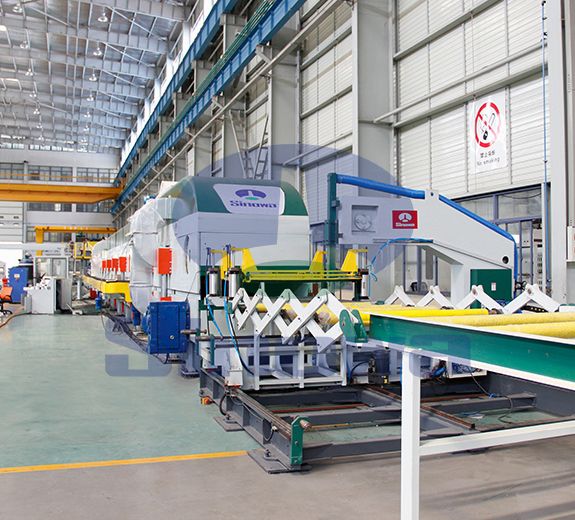
Based on the continuous technological pursuit, the pu sandwich panel machine developed by Sinowa provides you with high-efficiency industrial value. Based on China's cost advantage and our hard-working technology concept, our sandwich panel production line has a world-leading price-performance advantage. PU Sandwich Panel Machine can meet a variety of production needs of customers.The whole sandwich panel line design concept of modularization enables all our components to be integrated and combined at will.
Our pu sandwich panel machine can easily automate the production of roof sandwich panel, wall sandwich panel, cold storage sandwich panel and other products by different combination and configuration selection and siple switching. The inner core layer can be polyrethane or rock wool, glass wool, an so on.
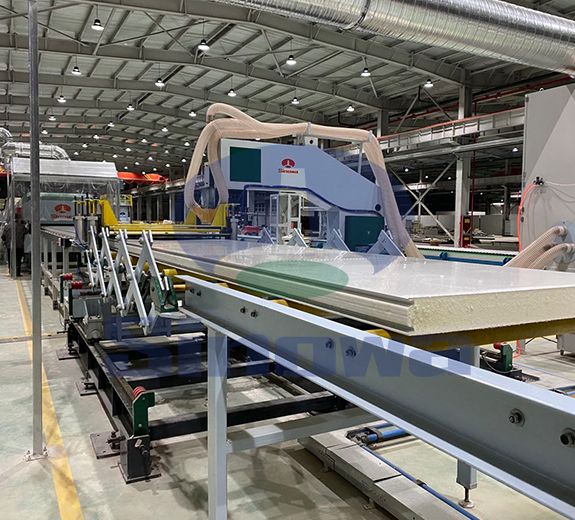
The pu sandwich panel machine has high adaptability, which may produce various sandwich panel of the PU, PIR and rock wool systems.
We may design various products according to the customer’s requirements, including various configurations, so as to meet their demands with flexible price system.
Highly integrated and linked control system centralizes all control points at the main central center, achieving parameter linkage, fault self-diagnosis controlled by the whole continuous sandwich panel line and shipping distance control.
High-level automatic control system also saves the manpower and reduces the manpower loss for customers.
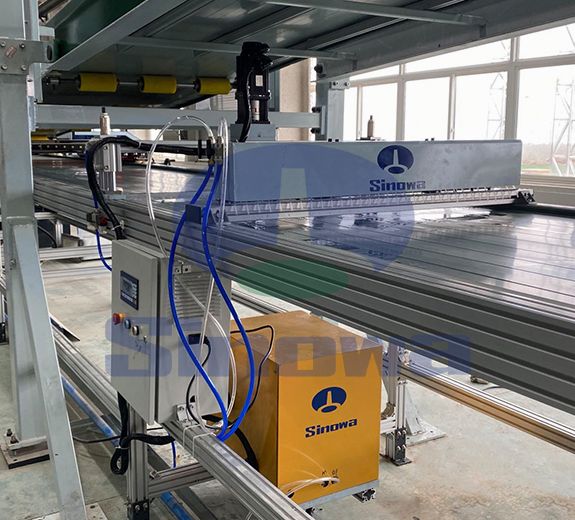
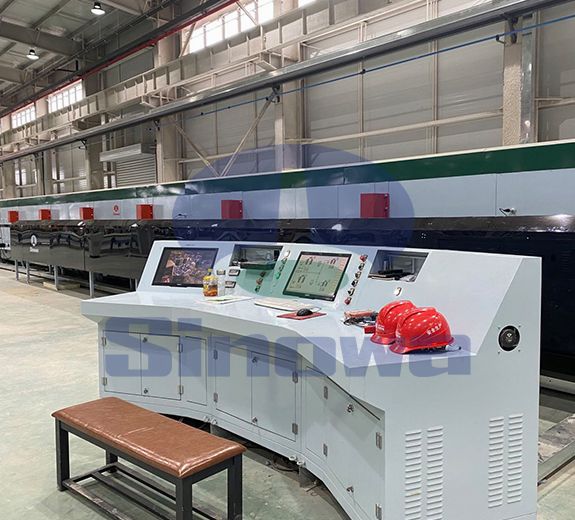
Concentrated system control is fully realized in the practice of concentrated process control so that the control system of all the movements of the parts in the pu sandwich panel machine is integrated in one process control console with accessible remote communication to elevate the automation and reduce the allocated number of personnel for the assembly line.
The main engine with modularized design achieves the precision operation of the pu sandwich panel machine, stable and reliable quality, less part and maintenance loss.
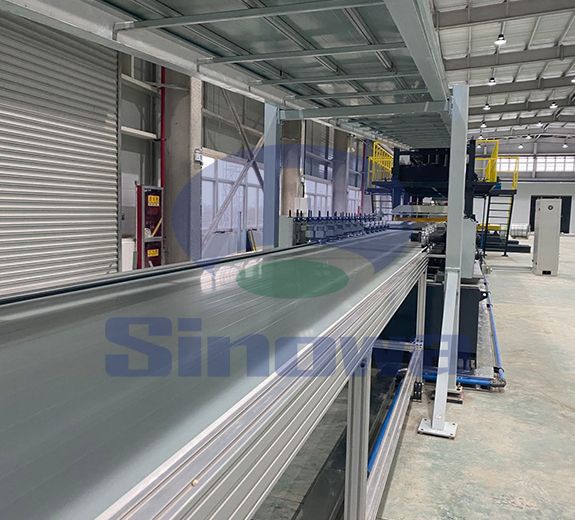
The whole pu sandwich panel machine is strictly modularized in design to ensure the greatest probability for the parts to be interchangeable, making it the most cost- and energy-saving. No joining made manually, all the key processes of the parts are completed in the machining center. As soon as the parts are inspected and warehoused, they enter into the assembly process. The modularized assembly can not only greatly increase the production efficiency but, most importantly, realize quick delivery as well. It elevates the reliability of product quality to a totally new level and minimizes the influence from human factors.
The whole pu sandwich panel machine has over 40 innovative inventions, making our products have lots of unique features and the comprehensive performance of our production line leading in the industry.
The precision servo hoisting mechanism employed by the main engine without hydraulic system makes the board thickness control flexible and the customer may conveniently change or adjust the board thickness. There will be not such troubles as hydraulic system adjustment, leakage, maintenance, etc.
High-level energy saving and protection design makes the whole pu sandwich panel machine possible to produce around the clock throughout the year and the customer will save huge budget. In addition, the isolated heat preservation room is constructed for warming the environment. The energy saving and protection design of our high-tech pu sandwich panel machine may guarantee that the customer’s production line may be freely heated and produce in the main time to save more costs for customers.
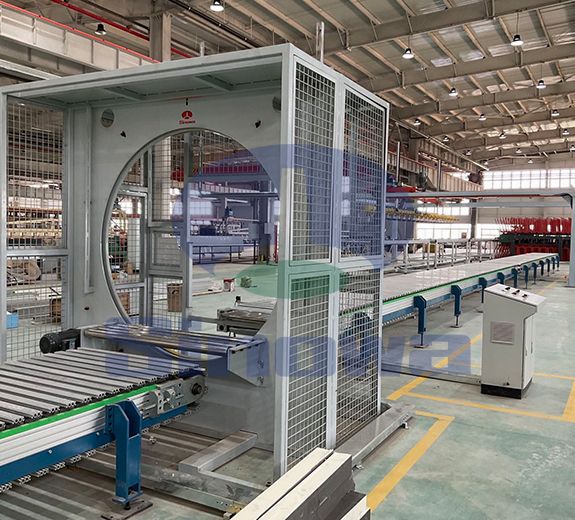
The high-power low-consumption design quickens the reaction of the pu sandwich panel machine while energy consumption is kept low.
With the brand-new, fully sealed inner insulation design, the energy consumption is controlled at the minimum level to achieve the design objective of less than an hour for the insulation system to be activated from the room temperature above 5℃ to the production process temperature.
The energy consumption is only 40% that of those similar products.
| PRODUCTION TYPE | PU | PIR | PHENOLIC | |||
|---|---|---|---|---|---|---|
| PRODUCTION USE | INSULATION PANEL | DOCORATIVE PANEL | ||||
| SURFACE OF SHEET | ALUMINUM FOIL | NON-WOVEN FABRIC | PAPER | NAKED | ||
| PRODUCT THICKNESS | 10m--- 200mm | |||||
| PRODUCTION SPEED | 3.0m---25m |
|---|---|
| FOAMING METHOD | TWO OR MULTI COMPONENTS FOAMING |
| FOAMING AGENT | PENTANE OR 141B |
| LENGTH OF LINE | 45m—100m CUSTOMER OPTIONAL |
Sinowa is a well-known manufacturer and technical service provider of high-end polyurethane insulation board production lines and various high-performance cold roll forming machine in China. Our main products include polyurethane double-sided color steel sandwich panel production line, polyurethane and phenolic soft facing insulation panel production line and high-efficiency roll forming machines.
Sinowa has invested outstanding efforts in both the insulation board production line and the roll forming line, This is why our products are more efficiency, quality, automatic control technology, environmental protection, energy consumption indicators and the appearance and safety protection are comprehensively leading, Some subversive design changes in many major technical points,these major innovations make our products excellent in price/performance and user experience.
Sinowa is committed to the development and manufacturing of high-end and high-efficiency sandwich panel production lines. Our sandwich panel production lines are leading the way in efficiency, automatic control, human-computer interaction, environmental protection and energy consumption. Using system integration and bus control technology, it realizes the automatic integrated linkage control of the entire production line, and can achieve remote interactive communication, which has the world-class level and a comprehensive leading high-performance production line in the market.
The global demand for polyurethane (PU) sandwich panel machines has maintained a steady upward momentum in recent years, driven by the booming development of downstream construction, cold chain logistics, and industrial manufacturing sectors. As core processing equipment for producing composite insulation panels, these machines integrate foaming, laminating, and shaping processes to manufacture lightweight, heat-insulating, and corrosion-resistant building materials. The sales trajectory of PU sandwich panel machines is closely intertwined with macroeconomic fluctuations, infrastructure investment cycles, industrial upgrading trends, and regional construction policies, forming a complex and dynamic market operation system. In the current global industrial context, the sales of such equipment not only reflect the development vitality of the building composite material industry but also mirror the overall investment willingness of manufacturing enterprises in intelligent and efficient production infrastructure.

One of the fundamental driving forces behind the growing sales of PU sandwich panel machines is the surging market demand for PU sandwich panels. These panels possess unique physical properties including low thermal conductivity, high structural stability, and convenient installation characteristics, making them indispensable in multiple application scenarios. In the construction industry, prefabricated buildings have become a mainstream development direction due to their advantages of short construction cycles and low resource consumption. A large number of temporary workshops, industrial warehouses, and modern public buildings adopt PU sandwich panels as wall and roof enclosure materials, which directly stimulates manufacturing enterprises to expand production capacity and purchase new processing equipment. In the cold chain industry, the strict insulation requirements of refrigerated warehouses and constant-temperature logistics facilities further increase the consumption of high-density PU sandwich panels, pushing related manufacturers to upgrade their production lines continuously. Additionally, the rising demand for clean rooms in the pharmaceutical, electronic, and food processing industries has also expanded the application boundary of such panels, indirectly boosting the market transaction volume of supporting production machines.
From a global regional sales perspective, the market distribution of PU sandwich panel machines presents obvious hierarchical characteristics, which are affected by regional economic development levels, industrial foundations, and policy orientations. In economically mature regions, the market demand mainly comes from equipment renewal and technological iteration. Many early-built production lines have problems such as low automation, high energy consumption, and unstable product precision after years of operation. Local manufacturers tend to eliminate backward equipment and purchase upgraded intelligent machines to optimize production efficiency and reduce long-term operating costs. In emerging industrial regions, infrastructure construction is in a stage of rapid expansion, and the local manufacturing industry is constantly improving its supporting system. The continuous influx of capital into the construction and manufacturing sectors has driven a large number of new production projects, bringing substantial incremental demand for PU sandwich panel machines. These regions have relatively low requirements for the advanced configuration of equipment in the initial stage, and cost-effective conventional models are more popular in the market, forming a differentiated sales structure with mature markets.
The technological evolution of PU sandwich panel machines is a key factor affecting market sales competitiveness. In the early stage of the industry, most equipment adopted semi-automatic processing modes, requiring a large amount of manual participation in raw material feeding, panel cutting, and finished product stacking. Such equipment has low production efficiency, inconsistent product batch quality, and high labor dependence, which can no longer adapt to the current large-scale industrial production needs. With the continuous progress of mechanical manufacturing and automatic control technology, modern PU sandwich panel machines have realized integrated automatic control of the whole production process. The optimized foaming system can accurately adjust the raw material ratio to ensure the uniform density of the sandwich layer, while the improved laminating structure enhances the bonding firmness between the surface plate and the polyurethane core material. The intelligent monitoring module can also track operating parameters such as equipment temperature, pressure, and operating speed in real time, effectively reducing the failure rate and material waste. The technological upgrading of equipment not only improves the production capacity of downstream enterprises but also accelerates the elimination of backward old equipment, thereby driving the continuous growth of equipment replacement sales volume.
The fluctuation of raw material prices in the industrial chain has an indirect regulatory effect on the sales rhythm of PU sandwich panel machines. The main raw materials required for the production of PU sandwich panels include polyurethane raw materials, metal color steel plates, and auxiliary chemical additives. The price changes of these raw materials will affect the profit margin of panel manufacturers and further influence their investment decisions on production equipment. When raw material prices remain stable for a long time, downstream enterprises have predictable profit expectations and are more willing to invest in expanding production scale or updating equipment, which promotes the growth of equipment sales. On the contrary, sharp and frequent raw material price fluctuations will make manufacturers tend to adopt a wait-and-see attitude, delay equipment procurement plans, and even shrink existing production capacity, resulting in a short-term decline in market transaction volume of PU sandwich panel machines. In addition, the logistics cost changes of raw materials and finished products will also affect the capital turnover efficiency of manufacturing enterprises, bringing subtle impacts on the equipment sales market.
Policy adjustments in various countries and regions play an indispensable guiding role in the sales development of the PU sandwich panel machine industry. In order to promote energy conservation and emission reduction in the construction industry, many regions have issued policies to restrict the use of high-energy-consuming and low-insulation traditional building materials, and explicitly encourage the promotion of lightweight and environmentally friendly composite insulation panels. This policy orientation has expanded the application scope of PU sandwich panels and created a favorable market environment for equipment sales. Meanwhile, the industrial support policies for the manufacturing industry, such as tax incentives for equipment renewal and financing support for small and medium-sized manufacturing enterprises, have reduced the procurement threshold of production equipment and stimulated the purchasing willingness of market entities. In some regions with strict environmental supervision, the upgraded PU sandwich panel machines with low noise and low waste emission have become the mainstream choice for manufacturers, while backward equipment with high pollution is gradually phased out under policy constraints, further optimizing the product sales structure of the equipment market.
Despite the overall growing sales trend, the PU sandwich panel machine industry still faces multiple restrictive challenges in the market operation process. The first challenge comes from the intensified market competition. With the continuous expansion of market demand, a growing number of mechanical manufacturing enterprises have entered the track of PU sandwich panel machine production, resulting in mixed product quality in the market. Some manufacturers cut production costs by simplifying equipment structures and reducing accessory configurations, occupying the low-end market with low-cost products. This homogeneous competition not only disrupts the benign price order of the industry but also weakens the profit space of high-quality equipment manufacturers. Secondly, the technical threshold difference of equipment brings market segmentation barriers. High-end intelligent equipment requires professional technical personnel for operation and maintenance, which is difficult for small-scale processing enterprises with insufficient technical reserves to adapt to, limiting the sales coverage of high-end equipment in low-end market groups. In addition, the after-sales service system of the industry is not perfect. Some equipment suppliers lack long-term maintenance and technical guidance mechanisms, which makes it difficult for buyers to solve equipment failure problems in a timely manner, reducing the repurchase willingness of downstream customers and affecting the long-term sales reputation of the industry.
To cope with market challenges and further expand sales scale, relevant participants in the industry have gradually formed diversified sales optimization strategies. In terms of product research and development, equipment manufacturers focus on differentiated product design, launching customized equipment models for different application scenarios. For example, simplified and easy-to-operate equipment is developed for small and medium-sized processing factories with low output requirements, while high-speed and high-precision intelligent production lines are customized for large-scale industrial manufacturers to meet the production needs of different customer groups. In terms of market sales channels, manufacturers have changed the traditional offline physical sales mode, combining online digital promotion with offline scene display. Through industrial platform promotion and industry exhibition displays, the exposure of equipment products is improved, and the communication efficiency with global customers is enhanced. In terms of after-sales service, more and more suppliers have begun to build localized service teams, providing regular equipment maintenance, personnel operation training, and remote fault diagnosis services to reduce the operating risks of customers and enhance customer stickiness. The improvement of the sales service system has become an important core competitiveness for equipment manufacturers to expand market share.
Looking ahead, the sales market of PU sandwich panel machines will continue to maintain an upward development trend, and the industry operation logic will be further optimized. The global prefabricated building construction wave will continue to advance, and the demand for energy-saving insulation panels in industrial plants, commercial buildings, and cold chain facilities will keep rising, providing stable downstream demand support for the equipment market. With the continuous penetration of intelligent manufacturing technology, the technical performance of PU sandwich panel machines will be further upgraded, and functions such as automatic intelligent detection, energy-saving operation optimization, and remote data management will become the standard configuration of mainstream equipment, promoting the continuous upgrading of market product structure. In terms of regional markets, the industrialization process of emerging regions will accelerate, and the demand for infrastructure supporting construction will drive the continuous growth of equipment incremental sales. Mature markets will still maintain stable renewal demand, forming a dual-market development pattern of incremental expansion and stock optimization.
In addition, the improvement of the global environmental protection industrial system will also inject new impetus into the sales of PU sandwich panel machines. The concept of green manufacturing has been popularized in various countries, and the environmental protection standards for building materials production are becoming increasingly stringent. The new generation of PU sandwich panel machines can effectively reduce the volatilization of chemical raw materials and the generation of production waste in the production process, which is more in line with green production requirements. Under the background of increasing environmental supervision, environmentally friendly and efficient equipment will gradually replace traditional backward products, bringing long-term growth space for the industry. At the same time, the improvement of the global logistics transportation system and the simplification of cross-border trade procedures will reduce the circulation cost of equipment, which is conducive to equipment manufacturers to expand overseas markets and optimize the global sales layout.
In conclusion, the sales development of PU sandwich panel machines is affected by multiple dimensions such as downstream industry demand, technological innovation, regional economy, and industrial policies. At this stage, the industry maintains an overall positive development trend, but it also faces problems such as homogeneous market competition and imperfect service systems. In the future, with the continuous progress of manufacturing technology, the gradual standardization of the industry order, and the sustained prosperity of downstream application markets, the sales volume of PU sandwich panel machines will achieve steady growth. Relevant market participants need to continue to focus on technological research and development, optimize product structure, improve service quality, and adapt to the differentiated needs of global customers, so as to realize the long-term and healthy development of the PU sandwich panel machine industry in the complex and changing market environment.
«Sales Of PU Sandwich Panel Machines» Update Date:2026/5/12
URL: https://www.sinowa.cn/en/blog/sales-of-pu-sandwich-panel-machines.html
Tags: Continuous PU Sandwich Panel Machine , PU Sandwich Panel Machine ,
