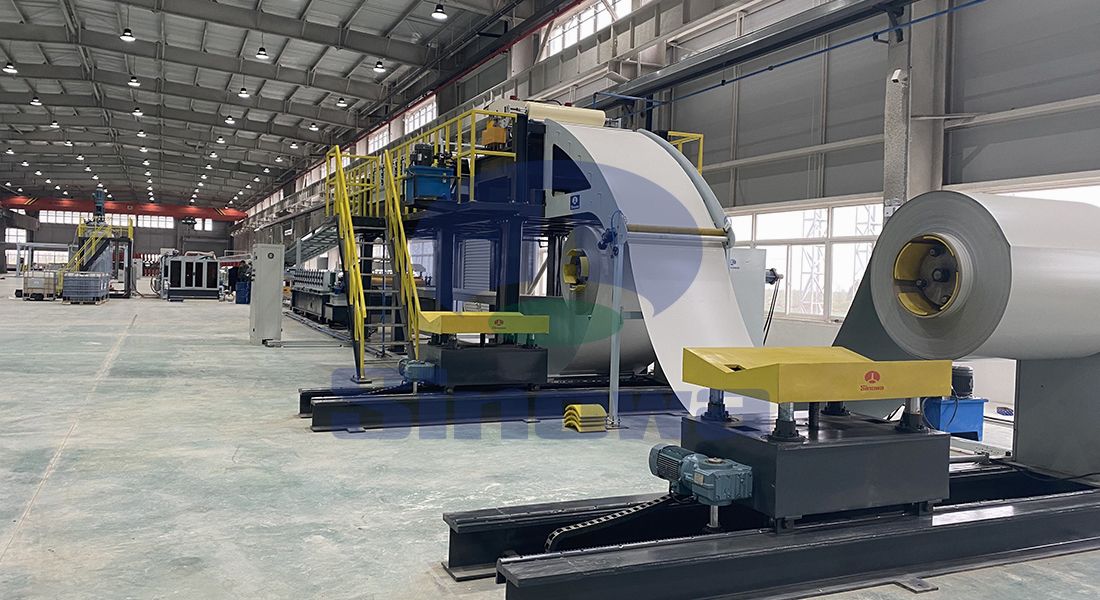
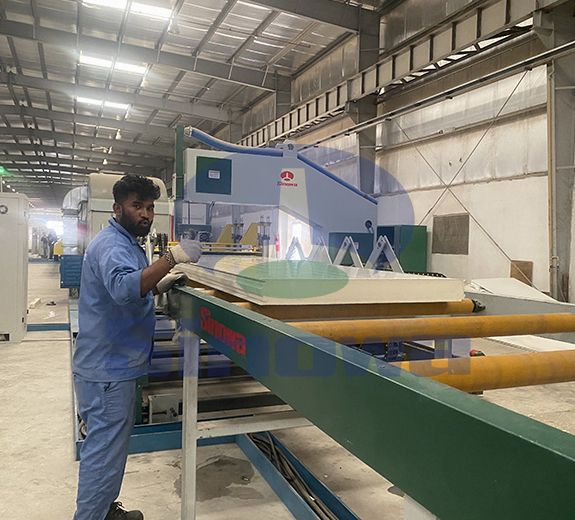
Sinowa is a well-known Composite Polyurethane Sandwich Panel Line Supplier From China, Dedicated to the research and development of high-end & high-efficiency polyurethane sandwich panel line, Sinowa is comprehensively taking the leading position in terms of efficiency, automation control level, HMI, environment protection and energy consumption, with subversive designs made in some critical technological fields to procure exceptional cost performance and customer-friendly experience for the entire polyurethane sandwich panel line.
The adoption of system integration technology and bus control technology accomplishes the full automatization of integrated and coordinated control of the entire polyurethane sandwich panel line with accessible remote interactive communication. Ranking the first-class level in the world, it is currently the continuous pu sandwich panel line in the market taking a comprehensive lead in high performance.
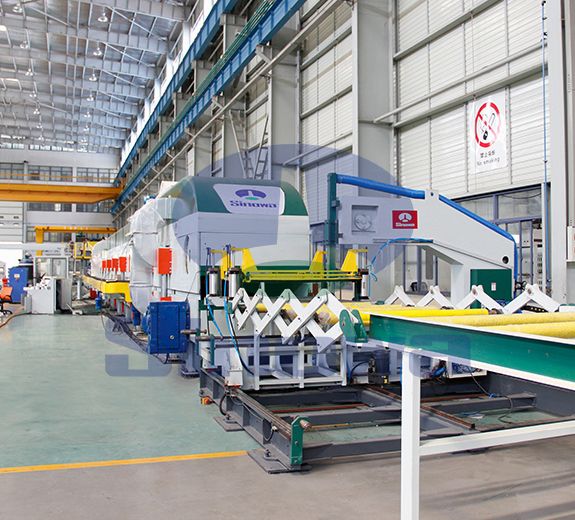
Based on the continuous technological pursuit, the polyurethane sandwich panel line developed by Sinowa provides you with high-efficiency industrial value. Based on China's cost advantage and our hard-working technology concept, our sandwich panel production line has a world-leading price-performance advantage. Polyurethane Sandwich Panel Line can meet a variety of production needs of customers.The whole sandwich panel line design concept of modularization enables all our components to be integrated and combined at will.
Our polyurethane sandwich panel line can easily automate the production of roof sandwich panel, wall sandwich panel, cold storage sandwich panel and other products by different combination and configuration selection and siple switching. The inner core layer can be polyrethane or rock wool, glass wool, an so on.
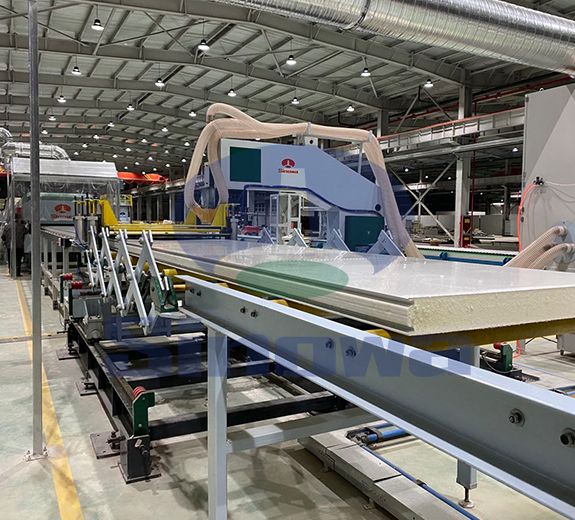
The polyurethane sandwich panel line has high adaptability, which may produce various sandwich panel of the PU, PIR and rock wool systems.
We may design various products according to the customer’s requirements, including various configurations, so as to meet their demands with flexible price system.
Highly integrated and linked control system centralizes all control points at the main central center, achieving parameter linkage, fault self-diagnosis controlled by the whole continuous sandwich panel line and shipping distance control.
High-level automatic control system also saves the manpower and reduces the manpower loss for customers.
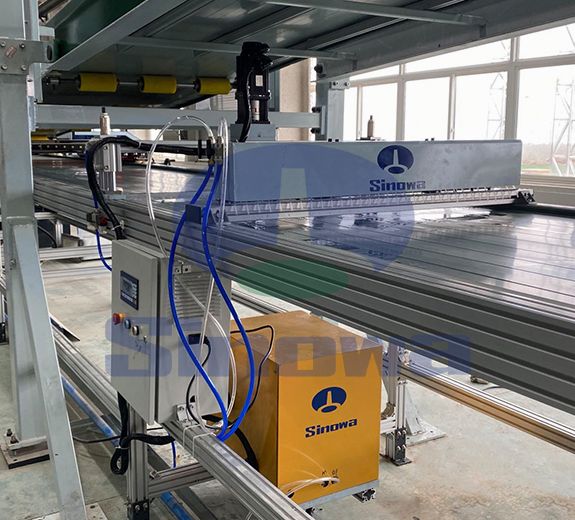
Concentrated system control is fully realized in the practice of concentrated process control so that the control system of all the movements of the parts in the polyurethane sandwich panel line is integrated in one process control console with accessible remote communication to elevate the automation and reduce the allocated number of personnel for the assembly line.
The main engine with modularized design achieves the precision operation of the polyurethane sandwich panel line, stable and reliable quality, less part and maintenance loss.
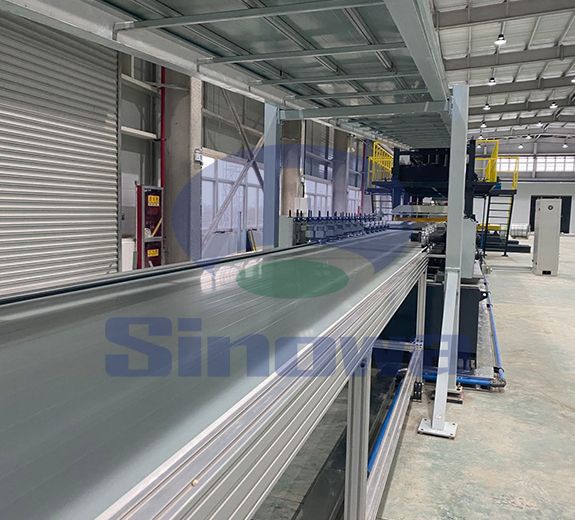
The whole polyurethane sandwich panel line is strictly modularized in design to ensure the greatest probability for the parts to be interchangeable, making it the most cost- and energy-saving. No joining made manually, all the key processes of the parts are completed in the machining center. As soon as the parts are inspected and warehoused, they enter into the assembly process. The modularized assembly can not only greatly increase the production efficiency but, most importantly, realize quick delivery as well. It elevates the reliability of product quality to a totally new level and minimizes the influence from human factors.
The whole polyurethane sandwich panel line has over 40 innovative inventions, making our products have lots of unique features and the comprehensive performance of our production line leading in the industry.
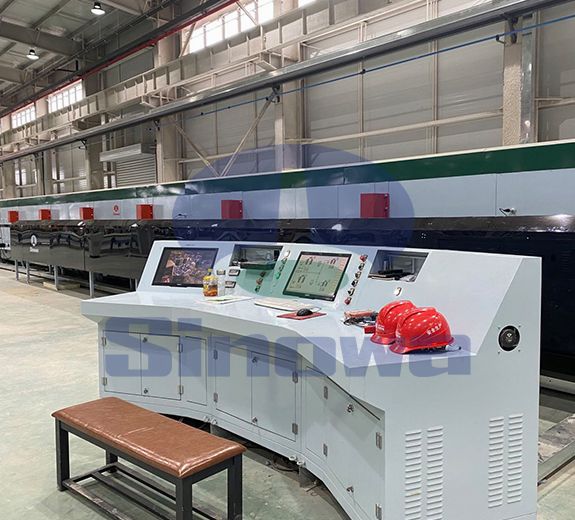
The precision servo hoisting mechanism employed by the main engine without hydraulic system makes the board thickness control flexible and the customer may conveniently change or adjust the board thickness. There will be not such troubles as hydraulic system adjustment, leakage, maintenance, etc.
High-level energy saving and protection design makes the whole polyurethane sandwich panel line possible to produce around the clock throughout the year and the customer will save huge budget. In addition, the isolated heat preservation room is constructed for warming the environment. The energy saving and protection design of our high-tech polyurethane sandwich panel line may guarantee that the customer’s production line may be freely heated and produce in the main time to save more costs for customers.
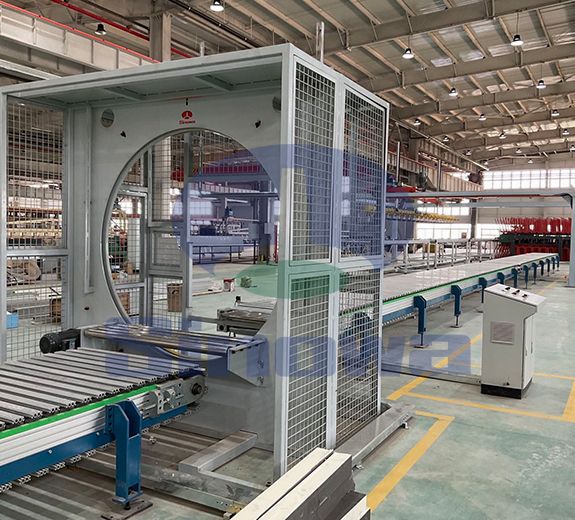
The high-power low-consumption design quickens the reaction of the polyurethane sandwich panel line while energy consumption is kept low.
With the brand-new, fully sealed inner insulation design, the energy consumption is controlled at the minimum level to achieve the design objective of less than an hour for the insulation system to be activated from the room temperature above 5℃ to the production process temperature.
The energy consumption is only 40% that of those similar products.
| PRODUCTION TYPE | PU | PIR | PHENOLIC | |||
|---|---|---|---|---|---|---|
| PRODUCTION USE | INSULATION PANEL | DOCORATIVE PANEL | ||||
| SURFACE OF SHEET | ALUMINUM FOIL | NON-WOVEN FABRIC | PAPER | NAKED | ||
| PRODUCT THICKNESS | 10m--- 200mm | |||||
| PRODUCTION SPEED | 3.0m---25m |
|---|---|
| FOAMING METHOD | TWO OR MULTI COMPONENTS FOAMING |
| FOAMING AGENT | PENTANE OR 141B |
| LENGTH OF LINE | 45m—100m CUSTOMER OPTIONAL |
Sinowa is a well-known manufacturer and technical service provider of high-end polyurethane insulation board production lines and various high-performance cold roll forming machine in China. Our main products include polyurethane double-sided color steel sandwich panel production line, polyurethane and phenolic soft facing insulation panel production line and high-efficiency roll forming machines.
Sinowa has invested outstanding efforts in composite polyurethane sandwich panel line, This is why our products are more efficiency, quality, automatic control technology, environmental protection, energy consumption indicators and the appearance and safety protection are comprehensively leading, Some subversive design changes in many major technical points,these major innovations make our products excellent in price/performance and user experience.
Sinowa is committed to the development and manufacturing of high-end and high-efficiency composite polyurethane sandwich panel line. Our sandwich panel production lines are leading the way in efficiency, automatic control, human-computer interaction, environmental protection and energy consumption. Using system integration and bus control technology, it realizes the automatic integrated linkage control of the entire production line, and can achieve remote interactive communication, which has the world-class level and a comprehensive leading high-performance production line in the market.
The continuous evolution of modern construction and industrial manufacturing sectors has created a growing demand for high-performance composite building materials that balance structural stability, thermal insulation, and production efficiency. Among these essential materials, polyurethane sandwich panels have emerged as a versatile solution widely utilized in architectural construction, cold chain logistics, industrial workshops, and decorative engineering. A composite polyurethane sandwich panel line serves as the core manufacturing system for producing such panels, integrating multiple mechanical units and automated control modules to realize continuous, streamlined, and standardized production of composite panels. This production system is designed to combine different surface substrates with polyurethane foam core materials through physical compounding and chemical foaming reactions, delivering finished panels with uniform thickness, stable structural performance, and excellent comprehensive properties. As industrial upgrading advances globally, the optimization and popularization of polyurethane sandwich panel production lines have become a key indicator measuring the development level of the composite material manufacturing industry.

A complete composite polyurethane sandwich panel line consists of multiple interconnected functional subsystems, each undertaking independent production tasks while maintaining precise coordination to ensure uninterrupted material transmission and processing. The fundamental structural composition of the production line includes a substrate unwinding and pretreatment unit, a raw material metering and mixing system, a continuous foaming and laminating unit, a shaping and curing mechanism, a trimming and cutting module, and a final stacking and discharging device. Every component is logically arranged in accordance with the sequential production process, forming a closed-loop production flow from raw material input to finished product output. Each functional unit adopts optimized mechanical structures to adapt to the physical characteristics of metal plates, non-metal substrates, and polyurethane chemical raw materials, effectively avoiding material deformation, foaming unevenness, and structural delamination during the production process.
The front-end section of the production line focuses on substrate preparation and pretreatment, which lays a solid foundation for subsequent composite molding. Raw substrates for sandwich panels are mostly supplied in rolled coils, and the unwinding device is responsible for stable and continuous material release. Equipped with an independent tension adjustment structure, this device precisely controls the stretching degree of the substrate to prevent wrinkles, deviations, and tensile deformation during high-speed transmission. After unwinding, the substrate passes through a flattening mechanism to eliminate internal stress generated during coiling, ensuring the flatness of the plate surface. In addition, the pretreatment process includes surface cleaning and simple coating treatment, removing dust, oil stains, and oxide layers on the substrate surface. This treatment enhances the adhesion between the substrate and polyurethane foam, effectively preventing interfacial peeling and delamination in long-term service and improving the overall durability of composite panels.
The raw material metering and mixing system acts as the core power source for polyurethane foaming, determining the foaming quality and internal structure of the sandwich panel core layer. Polyurethane composite materials require the mixing of multiple chemical raw materials, mainly including polyether resin, curing agents, foaming agents, and auxiliary additives. Each raw material is stored in independent sealed material tanks, with delivery volumes accurately controlled by variable-frequency metering pumps. Driven by independent variable-frequency motors, these pumps adjust operating speeds according to preset production parameters to achieve precise proportional distribution of different raw materials. After metering, all raw materials are transported to a high-speed mixing head for instantaneous homogeneous mixing, ensuring full fusion of chemical components. The well-mixed liquid materials are evenly coated on the surface of the lower substrate through a reciprocating material distribution mechanism, which moves horizontally at a stable speed to avoid local accumulation or sparse distribution of foaming materials, thus guaranteeing consistent core layer thickness across the entire panel.
The continuous foaming and laminating unit is the key processing section for panel composite molding, where chemical foaming and physical pressing are completed simultaneously. After the liquid polyurethane material is coated on the lower substrate, the upper substrate is automatically covered by a composite guiding structure, forming a sandwich composite structure with the foaming material sandwiched between two layers of substrates. The semi-finished composite plate then enters a double-belt laminating machine, the core equipment for molding. Inside the sealed cabin of the double-belt machine, a constant-temperature heating environment is maintained to trigger the foaming and cross-linking reaction of polyurethane materials. As the volume of the foaming material expands steadily, uniform pressure is generated between the upper and lower substrates. The adjustable clearance between the double belts accurately controls the thickness of the finished panel, while stable pressure binding eliminates internal bubbles and gaps. The collaborative control of temperature and pressure in this process ensures that the polyurethane foam forms a dense and uniform honeycomb structure, endowing the panel with excellent thermal insulation and mechanical buffering performance.
The shaping and curing process follows primary lamination, aiming to stabilize the internal molecular structure of polyurethane and enhance the bonding strength between layers. During the initial foaming stage, the polyurethane material remains in a semi-cured state with low structural stability. The continuous transmission of the double belt drives the semi-finished panels to pass through multi-stage constant-temperature curing sections, where graded temperature control is adopted to realize slow and complete curing of the foam material. This graded heating method effectively prevents internal stress concentration caused by rapid temperature changes, avoiding panel warping, bending, and surface cracking. The curing time is dynamically adjusted based on panel thickness and raw material ratios to ensure that the cross-linking reaction of polyurethane molecules reaches an optimal state. After curing, the integration degree between the foam core and the substrate is significantly improved, forming an inseparable composite structure and enhancing the overall compression resistance and shear resistance of the panel.
Post-processing modules such as trimming, cutting, and surface finishing further optimize the dimensional accuracy and appearance quality of finished panels. After curing and shaping, the edges of the composite panel have irregular residual materials and uneven widths. The automatic trimming devices installed on both sides of the production line cut off the excess edge materials to standardize the panel width. Equipped with high-precision sensing elements, the trimming system tracks the panel transmission trajectory in real time to correct cutting deviations and ensure neat and smooth cut edges. Subsequently, the fixed-length cutting mechanism executes precise segmentation according to preset length parameters. High-speed rotating cutting tools adopt optimized blade structures to achieve smooth cutting without burrs, reducing subsequent manual processing procedures. Some production lines are also equipped with surface flattening and deburring auxiliary structures to further polish the panel surface, improving surface flatness and appearance smoothness to meet diverse aesthetic and usage requirements.
The final stage of the production process involves automatic stacking and discharging, which improves production efficiency and reduces manual labor intervention. The finished panels after cutting are horizontally transmitted to the stacking platform through a conveyor belt. An intelligent mechanical stacking arm orderly arranges the panels according to standardized stacking specifications, maintaining consistent spacing and flat placement to prevent extrusion damage. The stacked finished products are transported to the finished product storage area by an auxiliary discharging device, completing the entire automated production workflow. The integrated design of stacking and discharging effectively solves the problems of scattered placement and cumbersome handling of finished products, realizing streamlined connection between production and storage, and laying a foundation for efficient product transportation and delivery.
Reasonable structural design and intelligent control logic endow the composite polyurethane sandwich panel line with prominent technical advantages in industrial production. In terms of production efficiency, the continuous assembly line structure realizes uninterrupted feeding, processing, and discharging, with a smooth production rhythm that effectively shortens the single-panel molding cycle. The automated control system centrally regulates parameters such as raw material ratio, heating temperature, lamination pressure, and cutting size, enabling one-click parameter setting and stable operation. This intelligent control mode reduces human errors caused by manual intervention and ensures consistent performance of each batch of finished panels. In terms of production flexibility, key parameters of the production line can be dynamically adjusted to manufacture panels with different thicknesses, widths, and surface materials, meeting the customized production needs of diverse application scenarios.
From the perspective of product performance, panels manufactured by advanced composite polyurethane sandwich panel lines have multiple superior physical properties. The dense honeycomb foam structure inside polyurethane provides excellent thermal insulation performance, effectively blocking heat transfer and reducing energy consumption for temperature regulation in buildings and storage spaces. The tight composite structure between the substrate and the foam core gives the panel high mechanical strength, enabling it to withstand external pressure and impact without easy deformation. Additionally, polyurethane materials have stable chemical properties, with good moisture resistance, corrosion resistance, and aging resistance. These characteristics allow the composite panels to maintain stable working performance in humid, high-temperature, and corrosive environments, extending their service life significantly compared with traditional building boards.
The application scope of products from composite polyurethane sandwich panel lines covers multiple industrial and civil fields. In the construction industry, these panels serve as wall and roof materials for temporary buildings, industrial plants, and public facilities, featuring convenient installation and light weight to reduce building load and construction cycles. In the cold chain storage industry, high-insulation polyurethane panels are used to build cold storage warehouses and constant-temperature storage spaces, maintaining internal temperature stability and lowering refrigeration energy consumption. In addition, such composite panels are also applied in transportation equipment, decorative engineering, and industrial purification workshops, providing lightweight, heat-preserving, and corrosion-resistant material solutions for different industries. With the continuous upgrading of market demand, the application scenarios of polyurethane sandwich panels are still expanding, driving the continuous technological iteration of supporting production lines.
In the context of global emphasis on energy conservation and environmental protection, the composite polyurethane sandwich panel line has outstanding environmental optimization characteristics in the production process. The closed raw material delivery system reduces volatile leakage of chemical materials, lowering air pollution during production. The foaming reaction process adopts environmentally friendly auxiliary materials, which do not produce harmful substances that damage the ecological environment. Moreover, the high thermal insulation performance of finished panels helps reduce long-term energy consumption of buildings and equipment, achieving the dual environmental protection goals of clean production and energy-saving application. The automated production mode also improves raw material utilization, reducing material waste generated in traditional intermittent processing methods and optimizing resource allocation efficiency.
Despite its mature application in the current industry, the composite polyurethane sandwich panel line still has broad room for technological upgrading and optimization. At present, the industry is gradually developing towards higher automation intelligence, introducing sensing monitoring and data feedback systems to realize real-time collection and intelligent adjustment of production data such as foaming density, bonding strength, and panel flatness. In terms of structural optimization, the production line is moving towards compact and modular design, simplifying equipment layout, reducing floor space, and facilitating equipment transportation, installation, and daily maintenance. In addition, research and development of new composite raw materials will further expand the performance boundaries of finished panels, prompting production lines to continuously adapt to new material processing technologies and realize diversified product iteration.
In conclusion, the composite polyurethane sandwich panel line is an indispensable key production system in the modern composite material industry. With its scientific process layout, intelligent control means, and efficient production capacity, it realizes large-scale standardized manufacturing of high-quality polyurethane sandwich panels. From raw material pretreatment to finished product stacking, each production link is precisely controlled and scientifically matched to ensure stable product quality and excellent comprehensive performance. Driven by the dual forces of market demand and technological innovation, this type of production line will continue to evolve in the direction of higher intelligence, lower energy consumption, and stronger customization capabilities. It will continuously provide reliable lightweight and energy-saving composite material products for the construction, cold chain, and industrial manufacturing industries, making important contributions to the high-quality development of the global new material manufacturing sector.
«Composite Polyurethane Sandwich Panel Line» Update Date:2026/5/13
URL: https://www.sinowa.cn/en/blog/composite-polyurethane-sandwich-panel-line.html
Tags: Polyurethane Sandwich Panel Line ,
