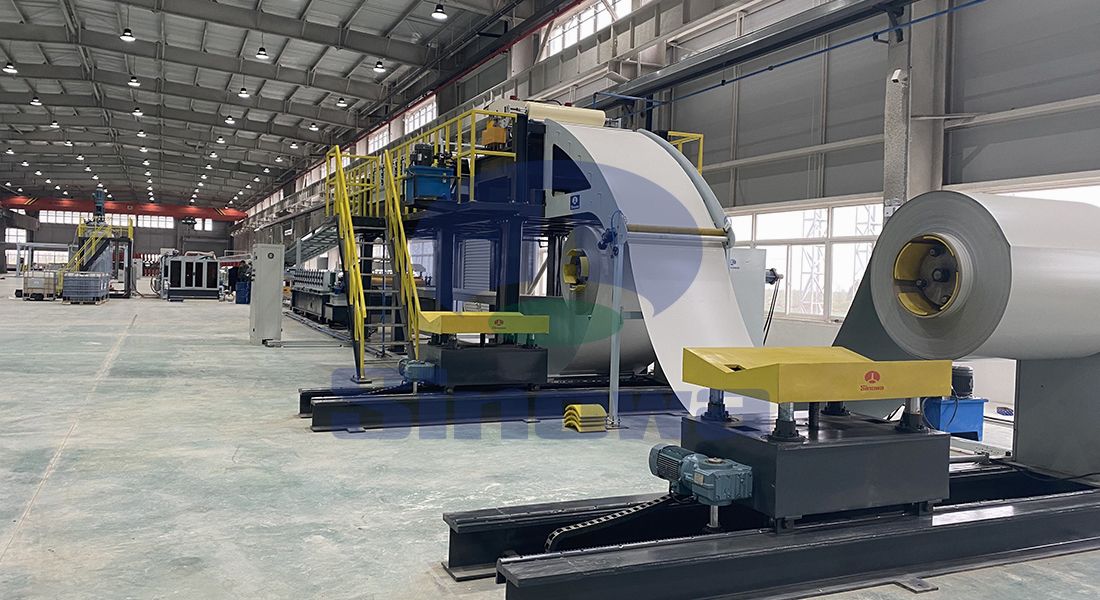
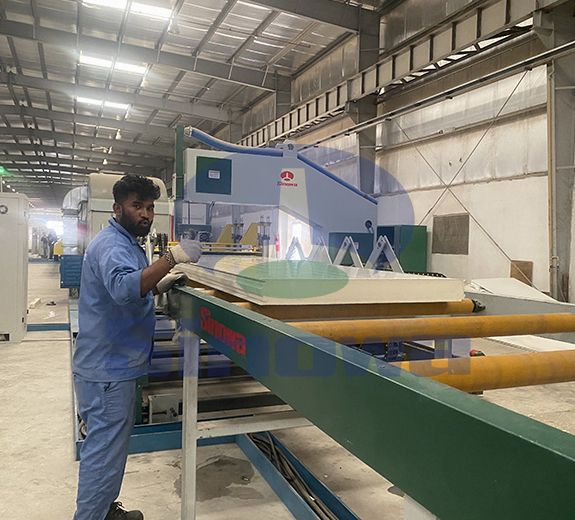
Sinowa is a well-known PU Sandwich Panel Line Supplier From China, Dedicated to the research and development of high-end & high-efficiency pu sandwich panel line, Sinowa is comprehensively taking the leading position in terms of efficiency, automation control level, HMI, environment protection and energy consumption, with subversive designs made in some critical technological fields to procure exceptional cost performance and customer-friendly experience for the entire pu sandwich panel line.
The adoption of system integration technology and bus control technology accomplishes the full automatization of integrated and coordinated control of the entire pu sandwich panel line with accessible remote interactive communication. Ranking the first-class level in the world, it is currently the continuous pu sandwich panel line in the market taking a comprehensive lead in high performance.
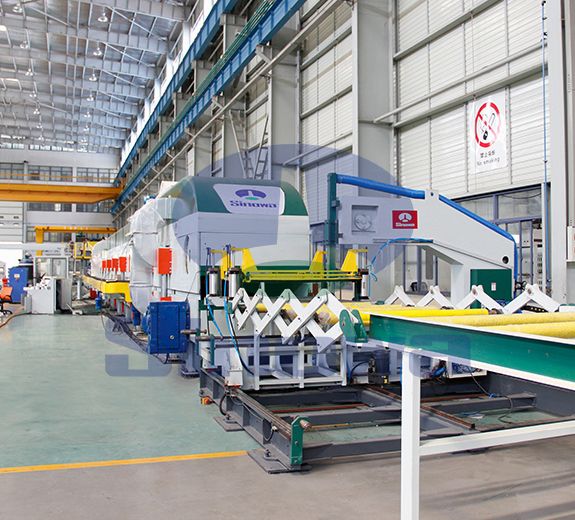
Based on the continuous technological pursuit, the pu sandwich panel line developed by Sinowa provides you with high-efficiency industrial value. Based on China's cost advantage and our hard-working technology concept, our sandwich panel production line has a world-leading price-performance advantage. PU Sandwich Panel Line can meet a variety of production needs of customers.The whole sandwich panel line design concept of modularization enables all our components to be integrated and combined at will.
Our pu sandwich panel line can easily automate the production of roof sandwich panel, wall sandwich panel, cold storage sandwich panel and other products by different combination and configuration selection and siple switching. The inner core layer can be polyrethane or rock wool, glass wool, an so on.
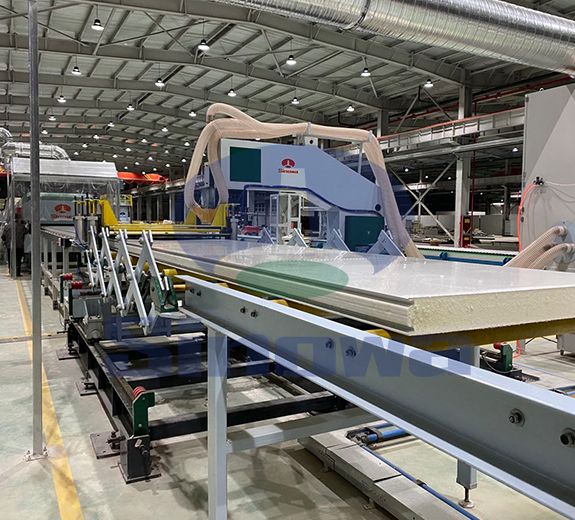
The pu sandwich panel line has high adaptability, which may produce various sandwich panel of the PU, PIR and rock wool systems.
We may design various products according to the customer’s requirements, including various configurations, so as to meet their demands with flexible price system.
Highly integrated and linked control system centralizes all control points at the main central center, achieving parameter linkage, fault self-diagnosis controlled by the whole continuous sandwich panel line and shipping distance control.
High-level automatic control system also saves the manpower and reduces the manpower loss for customers.
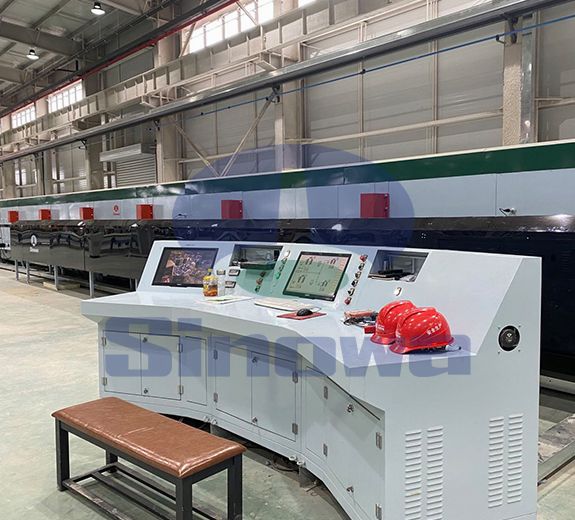
Concentrated system control is fully realized in the practice of concentrated process control so that the control system of all the movements of the parts in the pu sandwich panel line is integrated in one process control console with accessible remote communication to elevate the automation and reduce the allocated number of personnel for the assembly line.
The main engine with modularized design achieves the precision operation of the pu sandwich panel line, stable and reliable quality, less part and maintenance loss.
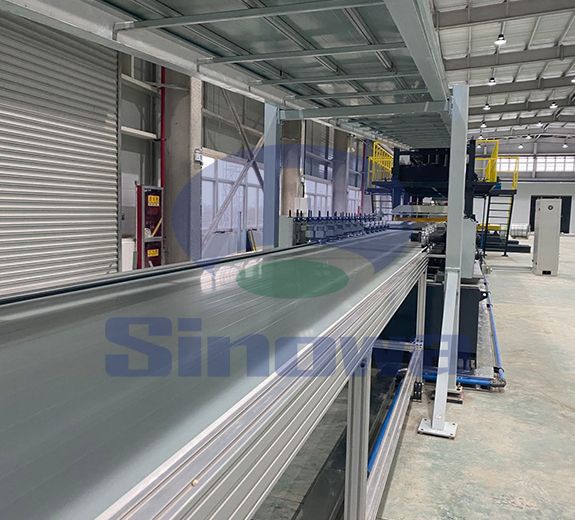
The whole pu sandwich panel line is strictly modularized in design to ensure the greatest probability for the parts to be interchangeable, making it the most cost- and energy-saving. No joining made manually, all the key processes of the parts are completed in the machining center. As soon as the parts are inspected and warehoused, they enter into the assembly process. The modularized assembly can not only greatly increase the production efficiency but, most importantly, realize quick delivery as well. It elevates the reliability of product quality to a totally new level and minimizes the influence from human factors.
The whole pu sandwich panel line has over 40 innovative inventions, making our products have lots of unique features and the comprehensive performance of our production line leading in the industry.
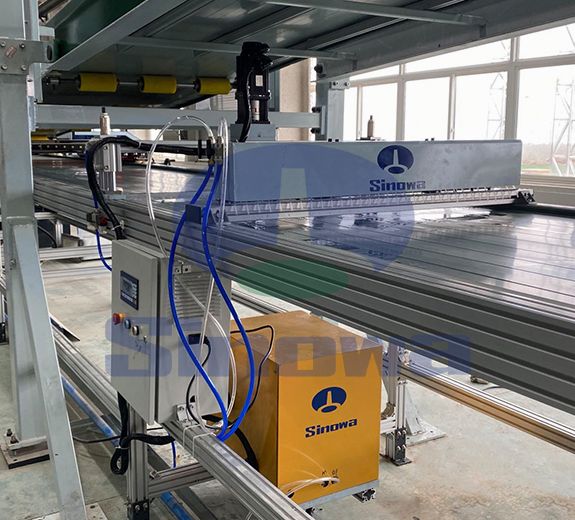
The precision servo hoisting mechanism employed by the main engine without hydraulic system makes the board thickness control flexible and the customer may conveniently change or adjust the board thickness. There will be not such troubles as hydraulic system adjustment, leakage, maintenance, etc.
High-level energy saving and protection design makes the whole pu sandwich panel line possible to produce around the clock throughout the year and the customer will save huge budget. In addition, the isolated heat preservation room is constructed for warming the environment. The energy saving and protection design of our high-tech pu sandwich panel line may guarantee that the customer’s production line may be freely heated and produce in the main time to save more costs for customers.
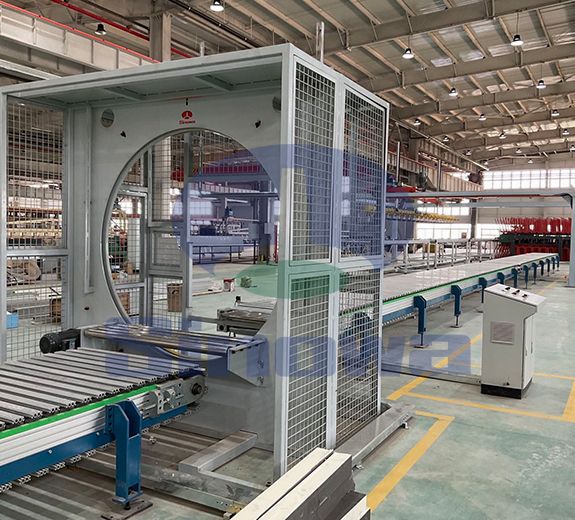
The high-power low-consumption design quickens the reaction of the pu sandwich panel line while energy consumption is kept low.
With the brand-new, fully sealed inner insulation design, the energy consumption is controlled at the minimum level to achieve the design objective of less than an hour for the insulation system to be activated from the room temperature above 5℃ to the production process temperature.
The energy consumption is only 40% that of those similar products.
| PRODUCTION TYPE | PU | PIR | PHENOLIC | |||
|---|---|---|---|---|---|---|
| PRODUCTION USE | INSULATION PANEL | DOCORATIVE PANEL | ||||
| SURFACE OF SHEET | ALUMINUM FOIL | NON-WOVEN FABRIC | PAPER | NAKED | ||
| PRODUCT THICKNESS | 10m--- 200mm | |||||
| PRODUCTION SPEED | 3.0m---25m |
|---|---|
| FOAMING METHOD | TWO OR MULTI COMPONENTS FOAMING |
| FOAMING AGENT | PENTANE OR 141B |
| LENGTH OF LINE | 45m—100m CUSTOMER OPTIONAL |
Sinowa is a well-known manufacturer and technical service provider of high-end polyurethane insulation board production lines and various high-performance cold roll forming machine in China. Our main products include polyurethane double-sided color steel sandwich panel production line, polyurethane and phenolic soft facing insulation panel production line and high-efficiency roll forming machines.
Sinowa has invested outstanding efforts in both the insulation board production line and the roll forming line, This is why our products are more efficiency, quality, automatic control technology, environmental protection, energy consumption indicators and the appearance and safety protection are comprehensively leading, Some subversive design changes in many major technical points,these major innovations make our products excellent in price/performance and user experience.
Sinowa is committed to the development and manufacturing of high-end and high-efficiency sandwich panel production lines. Our sandwich panel production lines are leading the way in efficiency, automatic control, human-computer interaction, environmental protection and energy consumption. Using system integration and bus control technology, it realizes the automatic integrated linkage control of the entire production line, and can achieve remote interactive communication, which has the world-class level and a comprehensive leading high-performance production line in the market.
The design of a PU sandwich panel production line represents a comprehensive integration of mechanical engineering, chemical reaction dynamics, thermal processing technology, and automated motion control, focusing on achieving continuous, stable, and high-quality manufacturing of composite building panels with polyurethane foam as the core insulation layer and rigid surface materials as the protective and structural outer layers. The core goal of professional PU sandwich panel line design is to balance structural mechanical stability, chemical foaming reaction accuracy, thermal curing uniformity, and production operation continuity, ensuring that every link from raw material input to finished panel output maintains consistent processing standards, adapts to diverse production demands for different panel specifications and application scenarios, and realizes long-term efficient operation with low energy consumption and minimal material waste. Unlike general simple mechanical production equipment, a PU sandwich panel line is a systematic engineering system composed of multiple interconnected functional modules, each of which has independent design focus and technical parameters, while all modules must maintain precise synchronous coordination in operation speed, processing rhythm, and parameter matching to avoid production defects such as uneven foam filling, inconsistent panel thickness, insufficient curing strength, and surface material deformation that affect the overall performance and service life of finished sandwich panels. The entire design process must fully consider the physical and chemical characteristics of polyurethane foam raw materials, the mechanical processing requirements of different surface substrate materials, the environmental adaptability of production workshops, and the subsequent storage, transportation, and application requirements of finished panels, forming a targeted and systematic design scheme that integrates front-end raw material pretreatment, mid-core foaming and composite molding, post-stage fixed-length cutting and finished product finishing, and overall intelligent control linkage.

The preliminary overall layout design of the PU sandwich panel line lays the foundational framework for the subsequent operation efficiency and production space utilization, and all layout planning must follow the principles of continuous material flow, compact space arrangement, convenient operation and maintenance, and reasonable environmental ventilation matching. In the overall spatial layout design, the production line is arranged in a linear continuous extending structure according to the sequential production process flow, avoiding cross operation and material back-and-forth transportation between different processing sections, which can effectively reduce unnecessary mechanical friction loss and production time delay in the production process, and ensure that surface materials, polyurethane chemical raw materials, and auxiliary processing materials are transported forward along a single fixed process route from the feeding starting point to the finished product stacking end point. The design fully reserves reasonable operation space on both sides of each functional processing module, facilitating daily manual patrol inspection, routine equipment maintenance, and rapid troubleshooting of minor mechanical failures without affecting the continuous operation of the main production line. At the same time, the overall layout takes into account the heat dissipation and ventilation requirements of the foaming and curing area, as the polyurethane foaming and polymerization curing process will generate a certain amount of reaction heat, and long-term high-temperature operation of the laminating and curing equipment also needs good heat dissipation conditions; reasonable spatial ventilation design can maintain the stability of the production microclimate in the key processing area, avoid local temperature accumulation affecting the foaming reaction rate and curing effect of polyurethane materials, and prevent the impact of high-temperature and humid production environment on the service life of mechanical transmission components and electrical control elements. In addition, the overall load-bearing foundation design of the production line is also a key part of the preliminary layout design. According to the total weight of each equipment module and the dynamic load generated by high-speed continuous operation, the foundation structure is optimized and reinforced to ensure that the production line does not produce vibration displacement and structural deformation during long-term continuous operation, because slight vibration and deformation in the production process will directly lead to deviations in panel thickness uniformity and foaming material distribution accuracy, resulting in unqualified finished panel products and increasing production loss.
The surface material feeding and pretreatment module is the initial functional unit of the entire PU sandwich panel line, and its design quality directly determines the flatness and dimensional stability of the upper and lower outer layers of the finished sandwich panels, laying a prerequisite foundation for subsequent foaming composite molding. The core design focus of this module is to realize continuous, stable, and tension-consistent feeding of coiled surface materials, and complete preliminary leveling, trimming, and surface cleaning treatment of the surface materials to eliminate adverse factors such as material bending deformation, edge burrs, and surface dust impurities that affect subsequent composite bonding effects. The decoiling part of the feeding module adopts a structural design with integrated tension self-adjustment and stable winding support, which can adapt to coiled surface materials of different specifications and weights, and maintain constant tension output during the entire decoiling and feeding process. The tension control structure is designed with flexible buffer adjustment components, which can automatically fine-tune the feeding tension in real time according to the feeding speed and material conveying resistance, effectively avoiding material tensile deformation caused by excessive tension or material stacking and deviation caused by insufficient tension. After decoiling, the surface material enters the multi-group leveling and straightening structure designed with multi-layer roller sets, and the number and arrangement of leveling rollers are scientifically designed according to the thickness and hardness of different surface materials. The upper and lower rollers are arranged in a staggered and matched manner, with precise gap adjustment functions, which can gradually correct the internal stress and surface bending deformation of the coiled material after long-term winding, ensuring that the surface material entering the subsequent composite process maintains a completely flat and straight state without local unevenness or warping deformation.
Subsequent edge trimming and surface cleaning sub-modules are also carefully optimized in design to meet the high-precision composite production requirements of sandwich panels. The edge trimming structure adopts a continuous fixed-size cutting design, which can trim the irregular edges on both sides of the surface material online in real time according to the set panel width specifications, ensuring that the width dimensions of the upper and lower surface materials are completely consistent, avoiding the problem of inconsistent edge sealing and uneven stress of the finished sandwich panels caused by width deviation. The surface cleaning part uses a combination of physical brushing and air blowing cleaning design, with high-density flexible brush rollers arranged in contact with the upper and lower surfaces of the material, matched with high-pressure uniform air flow blowing components, which can thoroughly remove dust, iron filings, and other sundries attached to the surface of the surface material. This design ensures that the bonding interface between the surface material and the polyurethane foam core layer is clean and dry, effectively improving the composite bonding strength between the surface layer and the core layer, preventing the occurrence of delamination and peeling between the panel layers in the later use process. All transmission and operation components of the entire feeding and pretreatment module adopt synchronous linkage design with the subsequent main production line, and the feeding speed is automatically matched with the operating speed of the foaming and laminating process in real time, realizing uninterrupted continuous feeding without manual speed adjustment intervention, ensuring the continuity and coordination of the entire production process from the initial link.
The polyurethane raw material metering, mixing, and pouring module is the core functional unit that determines the foaming quality, core layer density, and internal structural performance of the PU sandwich panel, and the design of this module focuses on ultra-precise raw material ratio control, uniform high-speed mixing, and stable quantitative pouring distribution, which is the key core link to ensure the thermal insulation performance and structural stability of the finished panel. Polyurethane foam for sandwich panel production is formed by the chemical reaction and foaming polymerization of two main raw materials and various functional auxiliary additives, and the proportional accuracy of all raw materials directly affects the foaming expansion ratio, cell structure uniformity, curing speed, and final physical and mechanical properties of the foam core layer. The metering part of the module adopts high-precision quantitative conveying structure design for each single raw material, with independent metering and conveying components configured for polyol, isocyanate, and various additives respectively. Each metering component is designed with real-time flow monitoring and automatic fine-tuning functions, which can accurately control the conveying flow of each raw material within a tiny error range, avoiding product quality problems such as too fast or too slow foaming reaction, uneven cell distribution, insufficient core layer hardness, or excessive foam brittleness caused by raw material ratio deviation.
The mixing structure design adheres to the high-pressure dynamic mixing principle, and the internal structure of the mixing head is optimized through fluid mechanics simulation, realizing instantaneous and uniform mixing of all raw materials in a limited mixing space. The internal flow channel of the mixing head adopts a streamlined anti-residue design, which can avoid raw material residue and local uneven mixing, and ensure that all chemical raw materials are fully fused before the foaming reaction starts, laying a good foundation for subsequent uniform foaming and curing molding. The temperature control structure is integrated into the metering and mixing module, and the temperature of each raw material storage tank, conveying pipeline, and mixing head is precisely controlled in real time. The chemical reaction activity of polyurethane raw materials is highly sensitive to temperature changes, and unreasonable temperature will lead to unstable reaction speed and inconsistent foaming effect; the designed constant temperature control system can maintain the raw material reaction temperature within the optimal fixed range at all times, ensuring that the foaming reaction proceeds stably according to the preset process rhythm. The pouring and distributing part after mixing adopts a uniform reciprocating pouring design, which can evenly distribute the mixed raw materials on the surface of the lower surface material moving forward continuously according to the set pouring width and thickness. The pouring position and pouring volume are automatically adjusted synchronously with the production line operating speed, ensuring that the raw material distribution on the entire width and length of the panel is uniform, avoiding local excessive or insufficient raw material pouring, and preventing problems such as hollow cores, uneven thickness, and inconsistent density of the foam core layer of the finished sandwich panels.
The continuous laminating and thermal curing module is the key processing unit for the composite molding and fixed curing of the upper and lower surface materials and the polyurethane foam core layer, and its design focuses on constant pressure lamination, zoned uniform temperature curing, and synchronous stable transmission, ensuring that the polyurethane foam completes foaming expansion, polymerization curing, and firm composite bonding with the surface materials in a closed stable environment. The main body of the laminating structure adopts a double-track circulating conveying and pressing integrated design, with upper and lower circulating track conveyor chains arranged symmetrically up and down, forming a closed lamination and curing channel. The distance between the upper and lower tracks is precisely adjusted according to the designed thickness specifications of the sandwich panels, and the pressure control structure is designed to output constant and uniform pressing force on the entire panel surface during the lamination process. The constant pressure design ensures that the polyurethane foam is uniformly compressed and expanded during the foaming process, the internal cell structure is compact and uniform, and the bonding between the foam core layer and the upper and lower surface materials is tight without gaps and delamination. Excessive pressure will lead to excessive compression of the foam core layer, reduced thermal insulation performance, and increased material loss, while insufficient pressure will result in loose foam structure, poor structural strength, and easy delamination of the panel layers, so the constant pressure precise control design is essential for the lamination process.
The thermal curing part adopts segmented zoned temperature control design, and the entire laminating and curing channel is divided into a preheating foaming zone, a constant temperature curing zone, and a post-curing heat preservation zone according to the different stages of polyurethane foaming and polymerization reaction. Each independent temperature zone is equipped with an independent heating and temperature sensing feedback structure, which can independently adjust and maintain the optimal temperature required for each reaction stage. In the preheating foaming zone, the temperature is set to adapt to the initial expansion and reaction start speed of polyurethane raw materials, promoting the initial uniform foaming of the foam; the constant temperature curing zone maintains a stable high-temperature environment to ensure that the polyurethane polymerization reaction is fully completed and the foam structure is rapidly shaped and solidified; the post-curing heat preservation zone slowly reduces the temperature to avoid structural cracks and internal stress concentration caused by rapid temperature change of the newly molded sandwich panel. The track transmission speed of the entire laminating and curing module is strictly synchronized with the feeding speed of the front-end feeding module and the pouring speed of the foaming module, maintaining a unified production rhythm, ensuring that the sandwich panel stays in the curing channel for a fixed time to complete sufficient curing molding, and avoiding unqualified products caused by insufficient curing time or excessive production speed. All contact parts between the laminating track and the panel are designed with smooth anti-stick and wear-resistant materials, which can prevent the polyurethane foam from adhering to the track during the curing process and avoid surface scratches and deformation of the finished panel during the transmission process.
The fixed-length cutting and edge finishing module undertakes the post-processing work of the continuously molded long-strip sandwich panels, and the design core is high-precision fixed-length cutting, smooth edge trimming, and burr-free finishing, ensuring that the dimensional accuracy of the finished panels meets the application standards and the edges and corners are neat and beautiful without processing defects. After the sandwich panel is completely cured and molded out of the laminating and curing module, it enters the fixed-length cutting sub-module for online real-time cutting according to the preset panel length specifications. The cutting structure adopts a high-speed stable cutting design with automatic length positioning and synchronous follow-up cutting function. The positioning system can accurately measure the conveying length of the panel in real time, and automatically start the cutting action when the panel reaches the set length; the follow-up cutting design ensures that the cutting tool and the panel keep synchronous moving speed during the cutting process, avoiding dimensional errors and section deformation caused by the relative speed difference between the cutting tool and the moving panel. The cutting tool is optimized with high-strength wear-resistant structural design, which can ensure a smooth and flat cutting section without burrs, cracks, and foam shedding, maintaining the integrity of the panel internal structure and surface flatness.
The edge finishing part carries out fine trimming and corner smoothing treatment on the cut edges and corners of the panel, removing tiny burrs and uneven residual materials generated during cutting, making the edges and corners of the finished sandwich panels neat and regular, which is convenient for subsequent on-site assembly and installation construction. The finishing structure adopts a flexible processing design, which can adapt to different panel thickness and edge shape requirements, and will not cause collision damage and surface wear to the panel surface during the finishing process. All actions of the fixed-length cutting and edge finishing module are automatically linked with the front-end production line operation, without manual positioning and operation, realizing continuous uninterrupted cutting and finishing production, effectively improving production efficiency and ensuring the consistency of panel dimensional accuracy and finishing effect. At the same time, the design is equipped with a waste recovery and cleaning structure for cutting and finishing residues, which can timely collect and process the generated leftover materials and debris, maintaining the cleanliness of the production environment and reducing material waste and environmental pollution in the production process.
The finished product conveying and automatic stacking module is the final link of the entire PU sandwich panel production line, and its design focuses on gentle conveying, stable transferring, and orderly automatic stacking, avoiding surface damage, collision deformation, and messy stacking of finished panels, and facilitating subsequent finished product storage, transportation, and outbound delivery. The finished product conveying part adopts a flexible roller conveying structure design, with reasonable roller spacing and smooth surface treatment, which can stably transport the finished panels after cutting and finishing without sliding, shaking, and surface scratching. The conveying speed is automatically matched with the cutting and stacking rhythm, ensuring the orderly transfer of panels between processes without accumulation and backlog. The automatic stacking structure is designed with multi-axis flexible moving and grabbing and placing components, which can automatically grab single finished panels from the conveying line according to the set stacking sequence and stacking height, and neatly stack them in the designated storage position. The grabbing part adopts a flexible contact protection design, which will not squeeze and damage the surface and edges of the panels during the grabbing and stacking process, effectively protecting the appearance quality and structural integrity of the finished products.
The stacking module is also designed with automatic counting and stacking position correction functions, which can accurately count the number of stacked panels in real time and automatically correct the stacking position to ensure that each stack of panels is stacked neatly with consistent specifications, convenient for subsequent inventory management and handling and transportation. The overall structure of the stacking module is compact and reasonable, occupying a small production space, and can realize automatic unmanned stacking operation, reducing manual labor input and avoiding panel damage and stacking irregularities caused by manual handling. At the same time, the design reserves a docking space for subsequent finished product packaging and handling equipment, which can be conveniently matched with subsequent supporting processing links, realizing the whole-process automated production from raw material feeding to finished product storage.
The core control and intelligent linkage system design is the central brain of the entire PU sandwich panel production line, undertaking the unified scheduling, real-time monitoring, parameter adjustment, and fault early warning and protection functions of all functional modules, and its design level directly determines the automation degree, production stability, and operation safety of the entire production line. The control system adopts integrated programmable control and human-computer interaction integrated design, integrating all operation parameters and action commands of feeding pretreatment, raw material metering and foaming, laminating and curing, cutting and finishing, and finished product stacking modules into a unified control platform. Operators can complete the setting of all production specifications such as panel thickness, width, length, production speed, and raw material ratio through the human-computer interaction interface, and the system automatically converts the set parameters into specific operation commands of each equipment module to realize one-key start and automatic continuous production of the entire line.
The real-time sensor monitoring network is an important part of the control system design, and a variety of high-precision sensors are installed in key positions of each production module to collect real-time data such as production operation speed, processing temperature, working pressure, raw material flow, and panel dimensional parameters. The control system automatically compares the collected real-time data with the preset standard parameters, and automatically carries out real-time fine-tuning of the operating status of each equipment module once parameter deviation is found, ensuring that all production links always run within the optimal process parameter range. The synchronous linkage control algorithm is optimized and upgraded for the core production rhythm, realizing precise synchronous matching of the operation speed and processing beat of all modules, avoiding production line shutdown and product quality problems caused by asynchronous operation between front and rear processes. In addition, the control system is designed with perfect fault automatic early warning and safety protection functions. When equipment abnormal operation, parameter exceeding the limit, or mechanical failure occurs in any link, the system will automatically send an early warning signal, display the fault location and cause in real time, and take automatic shutdown protection measures according to the fault severity, preventing equipment damage caused by fault expansion and ensuring the safety of production operation and equipment personnel.
The optimized design of production line energy saving, consumption reduction, and long-term stable operation is an indispensable part of the overall PU sandwich panel line design, conforming to the current development trend of efficient and low-consumption industrial production, and reducing the long-term production operation cost while ensuring production quality and efficiency. In terms of energy-saving design, all heating and power consumption components adopt high-efficiency energy-saving structural design and power consumption optimization configuration, reducing invalid energy consumption in the production process. The heating system of the laminating and curing module adopts heat recovery and heat preservation optimized design, recycling and reusing the waste heat generated in the curing process, and strengthening the heat preservation performance of the curing channel, reducing heat loss and heating energy consumption. All mechanical transmission components adopt low-friction and wear-resistant optimized design, reducing mechanical friction energy loss during long-term operation, and improving the overall mechanical operation efficiency of the equipment.
In terms of material consumption reduction, the raw material metering and pouring module adopts precise quantitative control design to avoid raw material waste caused by excessive pouring and ratio imbalance; the cutting and finishing module optimizes the cutting process parameters to reduce the generation of processing leftover materials and improve the utilization rate of raw materials. In terms of long-term stable operation design, all key mechanical components and electrical control parts adopt durable and wear-resistant structural design, and the equipment structure is optimized for anti-fatigue and anti-corrosion treatment, adapting to long-term continuous high-load industrial production conditions. The design is equipped with a regular automatic maintenance reminder and equipment operation data statistical function, which can record the long-term operation status and processing data of the production line, facilitate equipment managers to carry out targeted maintenance and upkeep work according to the operation data, effectively extend the service life of the production line equipment, and reduce equipment failure rate and later maintenance cost.
In summary, the design of a PU sandwich panel production line is a systematic and professional engineering work that involves multiple disciplines and multiple process links, requiring comprehensive consideration of mechanical structure performance, chemical reaction process, thermal processing conditions, automatic control level, energy-saving and consumption reduction requirements, and long-term operation stability. Every functional module and every detailed structural design is closely linked and mutually restricted, and only through scientific overall layout optimization, precise core process design, perfect intelligent linkage control, and reasonable long-term operation optimization can we build a high-performance PU sandwich panel production line. Such a production line can not only stably produce high-quality sandwich panels with excellent thermal insulation performance, good structural strength, and neat appearance specifications to meet the diverse application needs of building thermal insulation, enclosure structure, and industrial factory building construction, but also realize efficient, low-consumption, and stable long-term continuous production, creating reliable production value and economic benefits for industrial production and manufacturing enterprises. With the continuous upgrading of building energy-saving standards and the continuous expansion of the application market of PU sandwich panels, the design of PU sandwich panel production lines will also continue to develop in the direction of higher automation, higher production efficiency, lower energy consumption, and more diversified product adaptation, constantly optimizing and innovating in process technology and structural design to adapt to the changing market demand and industrial development trends.
«PU Sandwich Panel Line Design» Update Date:2026/4/29
URL: https://www.sinowa.cn/en/blog/pu-sandwich-panel-line-design.html
Tags: PU Sandwich Panel Lines , Continuous PU Sandwich Panel Line ,
