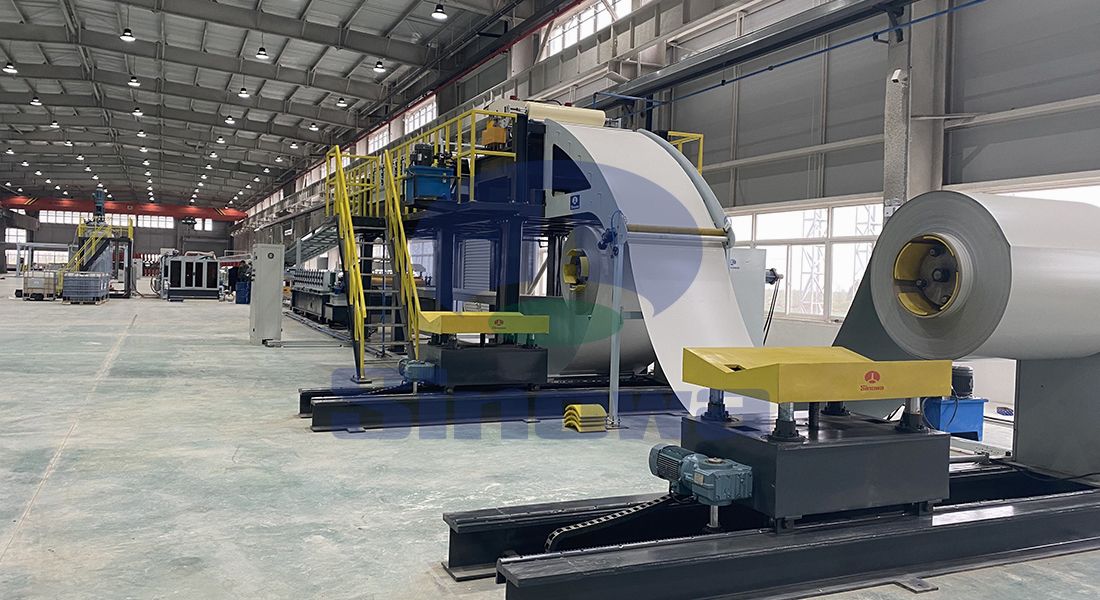
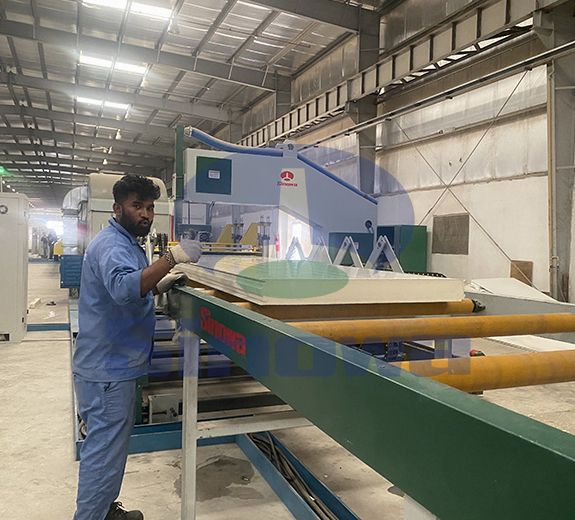
Sinowa is a well-known PU Sandwich Panel Production Line Supplier From China, Dedicated to the research and development of high-end & high-efficiency pu sandwich panel production line, Sinowa is comprehensively taking the leading position in terms of efficiency, automation control level, HMI, environment protection and energy consumption, with subversive designs made in some critical technological fields to procure exceptional cost performance and customer-friendly experience for the entire pu sandwich panel production line.
The adoption of system integration technology and bus control technology accomplishes the full automatization of integrated and coordinated control of the entire pu sandwich panel production line with accessible remote interactive communication. Ranking the first-class level in the world, it is currently the continuous pu sandwich panel line in the market taking a comprehensive lead in high performance.
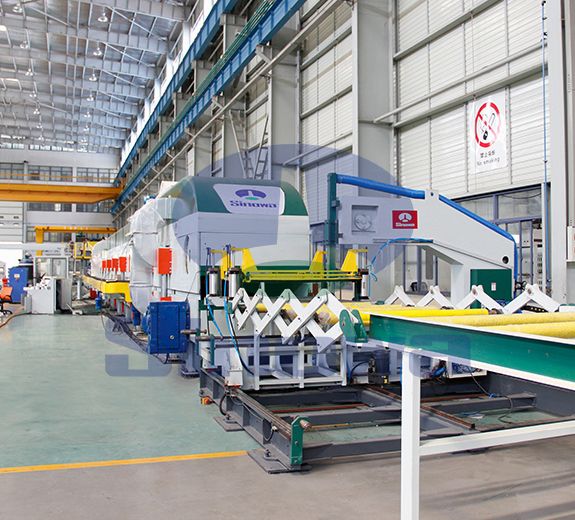
Based on the continuous technological pursuit, the pu sandwich panel production line developed by Sinowa provides you with high-efficiency industrial value. Based on China's cost advantage and our hard-working technology concept, our sandwich panel production line has a world-leading price-performance advantage. PU Sandwich Panel Production Line can meet a variety of production needs of customers.The whole sandwich panel line design concept of modularization enables all our components to be integrated and combined at will.
Our pu sandwich panel production line can easily automate the production of roof sandwich panel, wall sandwich panel, cold storage sandwich panel and other products by different combination and configuration selection and siple switching. The inner core layer can be polyrethane or rock wool, glass wool, an so on.
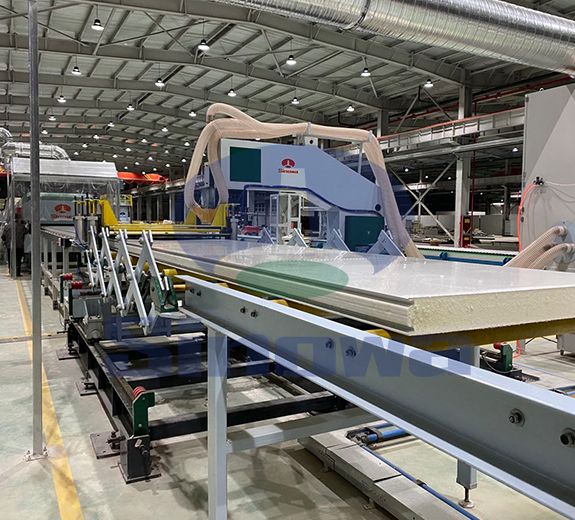
The pu sandwich panel production line has high adaptability, which may produce various sandwich panel of the PU, PIR and rock wool systems.
We may design various products according to the customer’s requirements, including various configurations, so as to meet their demands with flexible price system.
Highly integrated and linked control system centralizes all control points at the main central center, achieving parameter linkage, fault self-diagnosis controlled by the whole continuous sandwich panel line and shipping distance control.
High-level automatic control system also saves the manpower and reduces the manpower loss for customers.
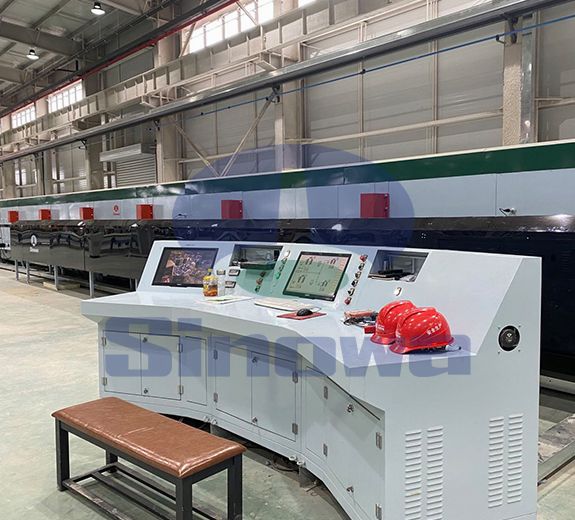
Concentrated system control is fully realized in the practice of concentrated process control so that the control system of all the movements of the parts in the pu sandwich panel production line is integrated in one process control console with accessible remote communication to elevate the automation and reduce the allocated number of personnel for the assembly line.
The main engine with modularized design achieves the precision operation of the pu sandwich panel production line, stable and reliable quality, less part and maintenance loss.
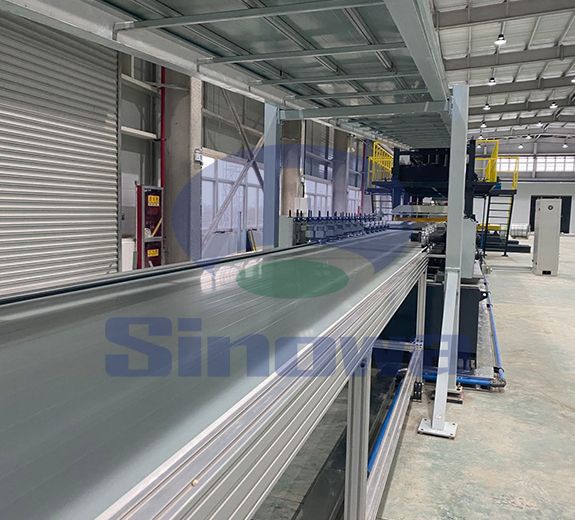
The whole pu sandwich panel production line is strictly modularized in design to ensure the greatest probability for the parts to be interchangeable, making it the most cost- and energy-saving. No joining made manually, all the key processes of the parts are completed in the machining center. As soon as the parts are inspected and warehoused, they enter into the assembly process. The modularized assembly can not only greatly increase the production efficiency but, most importantly, realize quick delivery as well. It elevates the reliability of product quality to a totally new level and minimizes the influence from human factors.
The whole pu sandwich panel production line has over 40 innovative inventions, making our products have lots of unique features and the comprehensive performance of our production line leading in the industry.
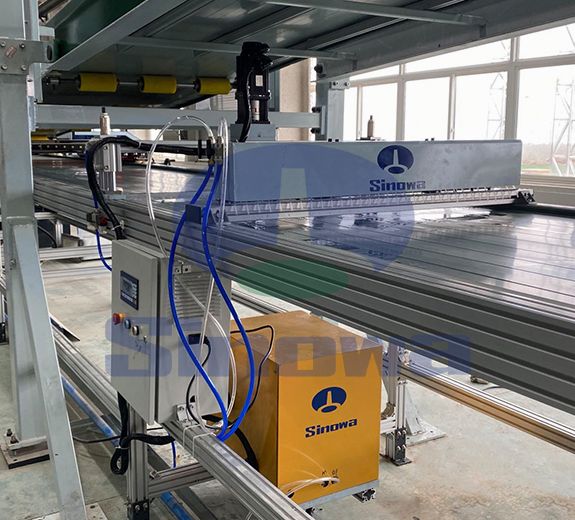
The precision servo hoisting mechanism employed by the main engine without hydraulic system makes the board thickness control flexible and the customer may conveniently change or adjust the board thickness. There will be not such troubles as hydraulic system adjustment, leakage, maintenance, etc.
High-level energy saving and protection design makes the whole pu sandwich panel production line possible to produce around the clock throughout the year and the customer will save huge budget. In addition, the isolated heat preservation room is constructed for warming the environment. The energy saving and protection design of our high-tech pu sandwich panel production line may guarantee that the customer’s production line may be freely heated and produce in the main time to save more costs for customers.
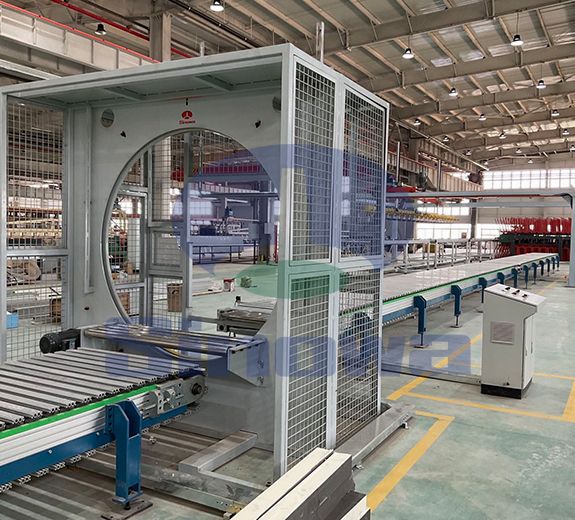
The high-power low-consumption design quickens the reaction of the pu sandwich panel production line while energy consumption is kept low.
With the brand-new, fully sealed inner insulation design, the energy consumption is controlled at the minimum level to achieve the design objective of less than an hour for the insulation system to be activated from the room temperature above 5℃ to the production process temperature.
The energy consumption is only 40% that of those similar products.
| PRODUCTION TYPE | PU | PIR | PHENOLIC | |||
|---|---|---|---|---|---|---|
| PRODUCTION USE | INSULATION PANEL | DOCORATIVE PANEL | ||||
| SURFACE OF SHEET | ALUMINUM FOIL | NON-WOVEN FABRIC | PAPER | NAKED | ||
| PRODUCT THICKNESS | 10m--- 200mm | |||||
| PRODUCTION SPEED | 3.0m---25m |
|---|---|
| FOAMING METHOD | TWO OR MULTI COMPONENTS FOAMING |
| FOAMING AGENT | PENTANE OR 141B |
| LENGTH OF LINE | 45m—100m CUSTOMER OPTIONAL |
Sinowa is a well-known manufacturer and technical service provider of high-end polyurethane insulation board production lines and various high-performance cold roll forming machine in China. Our main products include polyurethane double-sided color steel sandwich panel production line, polyurethane and phenolic soft facing insulation panel production line and high-efficiency roll forming machines.
Sinowa has invested outstanding efforts in both the insulation board production line and the roll forming line, This is why our products are more efficiency, quality, automatic control technology, environmental protection, energy consumption indicators and the appearance and safety protection are comprehensively leading, Some subversive design changes in many major technical points,these major innovations make our products excellent in price/performance and user experience.
Sinowa is committed to the development and manufacturing of high-end and high-efficiency sandwich panel production lines. Our sandwich panel production lines are leading the way in efficiency, automatic control, human-computer interaction, environmental protection and energy consumption. Using system integration and bus control technology, it realizes the automatic integrated linkage control of the entire production line, and can achieve remote interactive communication, which has the world-class level and a comprehensive leading high-performance production line in the market.
The design of a PU (Polyurethane) sandwich panel production line is a comprehensive engineering task that integrates material science, mechanical engineering, process optimization, and operational efficiency. It requires a systematic approach to ensure that the production line can stably produce high-quality PU sandwich panels with consistent performance, while also meeting the requirements of flexibility, energy efficiency, and safety. PU sandwich panels are widely used in various fields such as building insulation, industrial workshops, cold storage facilities, and transportation vehicles due to their excellent thermal insulation, sound insulation, lightweight, and high strength properties. The rationality of the production line design directly determines the quality of the final products, production efficiency, and long-term operational costs, making it a crucial link in the entire PU sandwich panel industry chain.

Before initiating the design of a PU sandwich panel production line, it is essential to conduct in-depth research and analysis of the market demand and product positioning. Different application scenarios have distinct requirements for the performance, specifications, and dimensions of PU sandwich panels. For example, panels used in cold storage facilities require higher thermal insulation performance, while those used in industrial workshops may prioritize structural strength and fire resistance. Panels for exterior wall applications need to have excellent weather resistance to withstand harsh environmental conditions such as UV radiation, rain, and temperature changes. Based on these specific requirements, the design parameters of the production line, including the thickness of the panel, the density of the PU core, the type of surface materials, and the production capacity, can be determined. This preliminary demand analysis lays the foundation for the subsequent design work, ensuring that the production line is not only technically feasible but also market-oriented.
The core of the PU sandwich panel production line design lies in the rational layout of the production process and the selection of appropriate equipment. A typical PU sandwich panel production line consists of several key process sections, including surface material uncoiling and leveling, PU foam mixing and pouring, composite pressing, curing, cutting, and stacking. Each section is closely connected, and the coordination between them directly affects the overall production efficiency and product quality. The layout of the production line should follow the principle of process continuity, minimizing the transportation distance of materials between different sections to reduce energy consumption and improve production efficiency. At the same time, it is necessary to consider the flexibility of the production line, allowing for quick adjustment of production parameters to adapt to the production of panels with different specifications and performance requirements.
The surface material processing section is the starting point of the production line. The surface materials of PU sandwich panels are usually color steel plates, aluminum plates, or other metal sheets, which need to be uncoiled, leveled, and cut to the required width before entering the composite process. The uncoiling equipment should have stable tension control to avoid wrinkles or deformation of the surface materials during the uncoiling process. The leveling machine is used to eliminate the internal stress of the metal sheets, ensuring that the surface is flat and smooth, which is crucial for the subsequent composite quality. The cutting equipment should have high precision to ensure that the width of the surface materials is consistent, laying a good foundation for the formation of the sandwich panel. In addition, some production lines may also include a surface treatment process for the metal sheets, such as coating or galvanizing, to enhance their corrosion resistance and service life. However, this process needs to be integrated into the production line layout reasonably to avoid affecting the overall production rhythm.
The PU foam mixing and pouring section is the key link that determines the performance of the PU core. PU foam is formed by the reaction of isocyanate and polyol, and the mixing ratio, mixing speed, and pouring temperature of these two components have a significant impact on the density, thermal conductivity, and mechanical properties of the foam. Therefore, the mixing equipment must have high precision and stability. The mixing head should be able to fully mix the two components evenly, and the mixing speed can be adjusted according to the production requirements. The pouring system needs to have accurate flow control to ensure that the amount of foam poured between the two surface materials is consistent, avoiding uneven thickness of the PU core. In addition, the temperature of the mixing and pouring process should be strictly controlled, usually between 20℃ and 30℃, to ensure the smooth progress of the chemical reaction. Some advanced production lines may adopt automatic temperature control systems and flow monitoring devices to further improve the stability and consistency of the PU foam quality.
The composite pressing section is responsible for bonding the surface materials and the PU core into an integral sandwich panel. The pressing equipment usually consists of a conveyor belt and a pressing roller system. The conveyor belt transports the surface materials and the poured PU foam forward at a constant speed, while the pressing rollers apply a uniform pressure to ensure that the PU foam is fully bonded with the surface materials and that the thickness of the sandwich panel meets the design requirements. The pressure and speed of the pressing rollers need to be adjusted according to the type of surface materials and the density of the PU core. Excessive pressure may cause the PU core to be compressed too much, reducing its thermal insulation performance; insufficient pressure may lead to poor bonding between the surface materials and the PU core, affecting the structural strength of the panel. In addition, the pressing section should be equipped with a deviation correction device to ensure that the surface materials do not deviate during the conveying process, ensuring the uniformity of the panel width and edge quality.
The curing section is an important part to ensure the stability of the PU sandwich panel performance. After the composite pressing, the PU foam needs a certain period of time to complete the chemical reaction and solidify into a stable structure. The curing process can be divided into natural curing and artificial curing. Natural curing is simple and low-cost, but it is greatly affected by the ambient temperature and humidity, and the curing time is relatively long, which may affect the production efficiency. Artificial curing, on the other hand, uses heating equipment to control the temperature and humidity of the curing environment, which can shorten the curing time and improve the curing quality. The curing chamber should have good thermal insulation performance to ensure uniform temperature distribution inside, avoiding local overheating or insufficient curing of the PU foam. The curing temperature is usually controlled between 40℃ and 60℃, and the curing time varies according to the thickness of the PU core and the formula of the foam. During the curing process, it is necessary to monitor the temperature and humidity in real time and adjust them in a timely manner to ensure that the PU foam can fully cure and achieve the expected performance.
After the curing process, the PU sandwich panel enters the cutting section. The cutting equipment needs to cut the continuous panel into pieces of the required length according to the customer's requirements. The cutting precision is crucial, as it directly affects the installation efficiency and quality of the panels. The cutting equipment should be equipped with high-precision cutting tools and a positioning system to ensure that the length and diagonal of the cut panels are accurate. In addition, the cutting process should be smooth to avoid burrs or damage to the surface of the panels. Some advanced cutting equipment can also realize automatic cutting and length adjustment, improving production efficiency and reducing manual operation errors. After cutting, the panels need to be inspected for size, flatness, and surface quality, and unqualified products should be sorted out in a timely manner to ensure the overall quality of the finished products.
The stacking section is the end of the production line. The stacked panels need to be arranged neatly and stably to avoid deformation or damage during storage and transportation. The stacking equipment should have a stable lifting and conveying system, which can stack the panels according to a certain number and height. At the same time, it is necessary to consider the weight of the panels to avoid excessive stacking pressure that may damage the panels at the bottom. The stacking area should be kept clean and dry, and the panels should be protected from moisture, dust, and other contaminants. In addition, the stacking method should be convenient for loading and unloading, improving the efficiency of subsequent transportation and storage.
In addition to the design of the main process sections, the auxiliary systems of the production line also need to be considered comprehensively. The electrical control system is the "brain" of the production line, responsible for controlling the operation of all equipment, monitoring the production process, and handling faults. The electrical control system should be stable and reliable, with a user-friendly operation interface, allowing operators to easily set production parameters, monitor production status, and troubleshoot. The power supply system should be able to provide stable power to ensure the normal operation of all equipment. The ventilation and dust removal system is used to remove dust and harmful gases generated during the production process, ensuring a safe and healthy working environment for operators. The waste treatment system is responsible for handling the waste generated during production, such as leftover materials and waste foam, to reduce environmental pollution and realize resource recycling.
Energy efficiency and environmental protection are important considerations in the design of modern PU sandwich panel production lines. With the increasing emphasis on environmental protection and energy conservation, the production line design should adopt energy-saving technologies and equipment to reduce energy consumption and environmental pollution. For example, the heating equipment in the curing section can adopt energy-saving heating methods such as solar energy or waste heat recovery to reduce the consumption of traditional energy sources. The mixing equipment can adopt frequency conversion technology to adjust the motor speed according to the production load, saving electricity. The waste foam generated during production can be recycled and reused to reduce resource waste. In addition, the production line should be designed in accordance with environmental protection standards, with effective treatment measures for waste water, waste gas, and solid waste to ensure that the production process meets environmental protection requirements.
The flexibility and expandability of the production line are also important factors to consider in the design. The market demand for PU sandwich panels is constantly changing, and the production line should be able to quickly adapt to changes in product specifications and performance requirements. This can be achieved through the modular design of the production line, where each process section is designed as an independent module, making it easy to replace or add equipment according to production needs. In addition, the production line should have a certain expansion space to allow for the increase of production capacity in the future. This not only reduces the cost of subsequent transformation but also improves the competitiveness of the enterprise in the market.
Safety is another crucial aspect of the production line design. The production process involves flammable and explosive materials such as isocyanate and polyol, so the production line must be equipped with complete safety protection measures. The mixing and pouring section should be equipped with explosion-proof equipment and fire-fighting facilities to prevent fire and explosion accidents. The electrical system should be explosion-proof and waterproof to avoid electrical faults caused by leakage. The operators should be provided with personal protective equipment such as gloves, goggles, and masks to protect their personal safety. In addition, safety training should be carried out regularly for operators to improve their safety awareness and emergency handling capabilities.
The design of the PU sandwich panel production line also needs to consider the maintenance and operation of the equipment. The equipment should be easy to maintain, with convenient access to spare parts and simple maintenance procedures. This can reduce the downtime of the production line and improve the utilization rate of the equipment. The operation of the equipment should be simple and easy to learn, reducing the training cost for operators. In addition, the production line should be equipped with a fault diagnosis system to quickly identify and locate equipment faults, facilitating timely maintenance and reducing the impact on production.
In the actual design process, it is necessary to comprehensively balance various factors such as product quality, production efficiency, energy consumption, environmental protection, safety, and cost. It is necessary to conduct in-depth communication with equipment suppliers, material suppliers, and end users to understand their needs and suggestions, and continuously optimize the design scheme. In addition, the design scheme should be verified through simulation tests or small-scale trial production to ensure its feasibility and rationality before formal implementation. With the continuous development of science and technology, new materials, new equipment, and new processes are constantly emerging, which also provides new opportunities and challenges for the design of PU sandwich panel production lines. Designers need to keep abreast of the latest technological trends and continuously innovate the design concept to design more efficient, energy-saving, and environmentally friendly PU sandwich panel production lines.
In conclusion, the design of a PU sandwich panel production line is a complex and systematic project that requires comprehensive consideration of multiple factors. From the preliminary demand analysis to the detailed design of each process section, from the selection of equipment to the configuration of auxiliary systems, every link needs to be carefully designed and optimized. A well-designed production line can not only ensure the stable production of high-quality PU sandwich panels but also improve production efficiency, reduce operational costs, and enhance the competitiveness of the enterprise. With the continuous expansion of the application field of PU sandwich panels, the requirements for the production line design will become higher and higher, which requires designers to have a solid professional foundation, rich practical experience, and innovative thinking to meet the changing market needs and promote the healthy development of the PU sandwich panel industry.
«PU Sandwich Panel Production Line Design» Update Date:2026/5/7
URL: https://www.sinowa.cn/en/blog/pu-sandwich-panel-production-line-design.html
Tags: PU Sandwich Panel Production Line , Continuous PU Sandwich Panel Production Line ,
